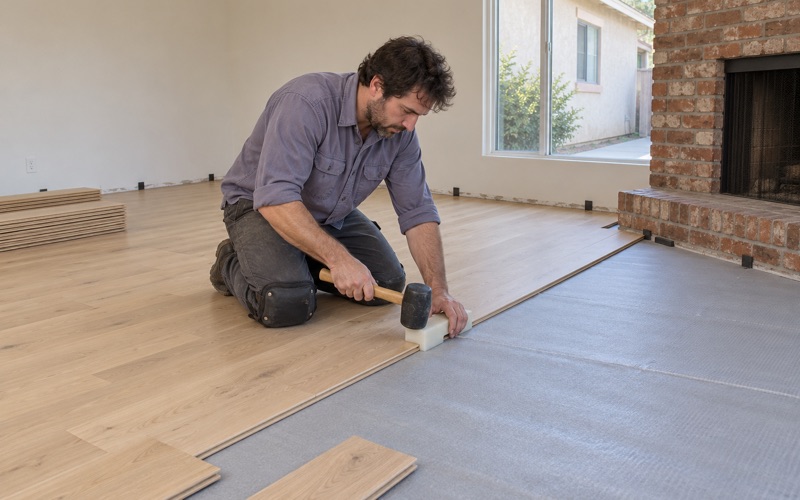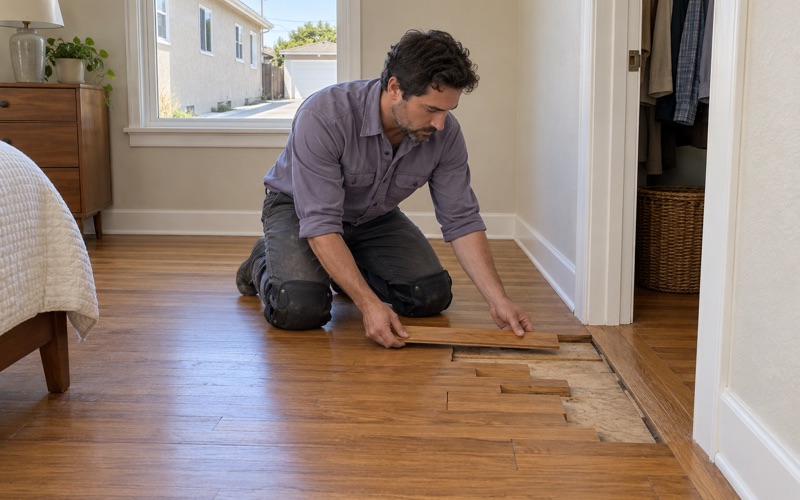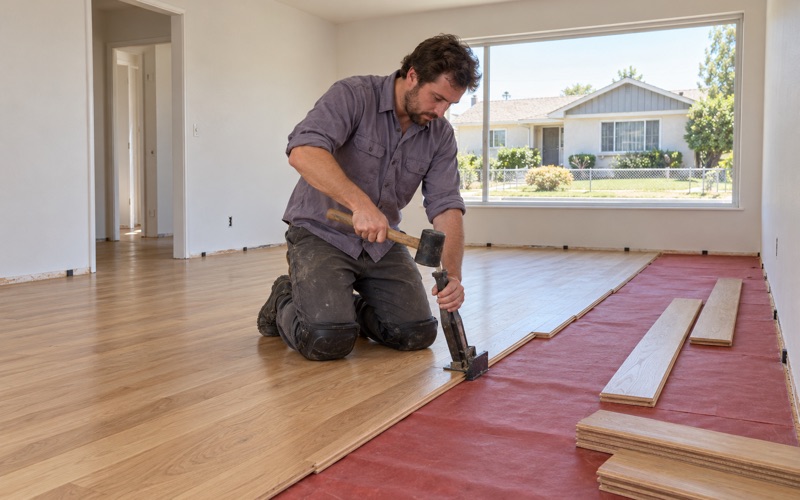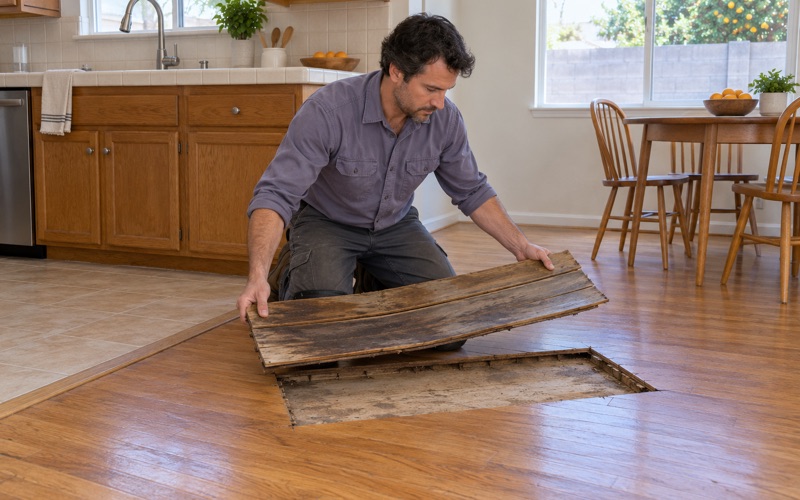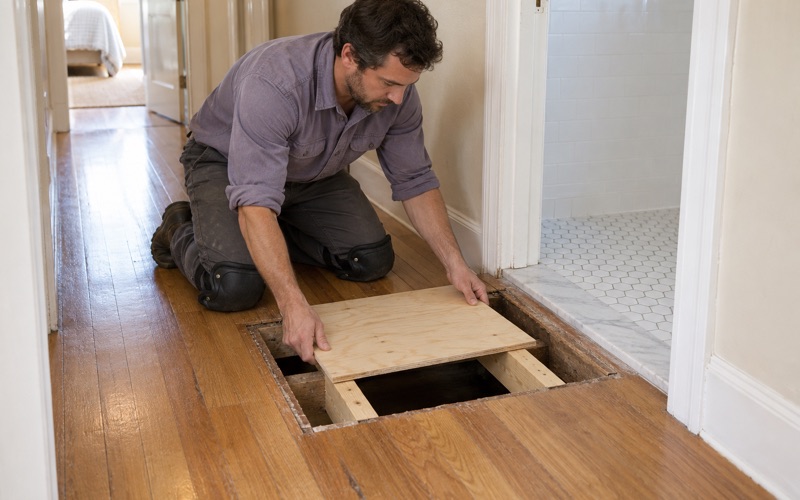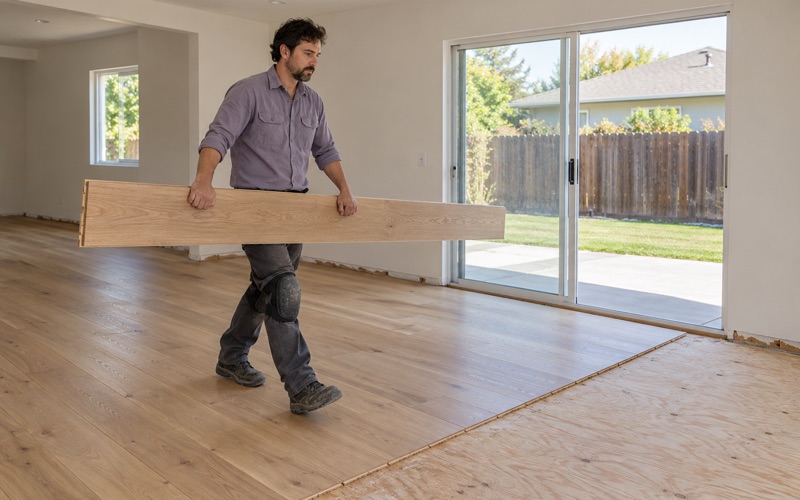
Lakewood Wood Flooring has done wood flooring in Commerce for homeowners who want a sound, good-looking floor without giving up the use of their house for longer than the work truly takes. Across more than 20 years, most of these jobs have been one of three things: a worn floor that needs a full refinish, new boards going down where carpet used to be, or a section that took water and has to be cut out and rebuilt. Every one of them starts with a walk through the rooms and a written estimate broken out line by line.
Before we order anything, we take readings with a wood moisture meter and test any concrete involved, and those numbers go on paper where you can see them. Soft, bouncy or sagging spots get traced down through the subfloor to the joists, and if what we find is a structural repair rather than a flooring job, we tell you and refer it out. Old linoleum, rubber tile and 9x9 tile are handled as a possible asbestos question before anyone scrapes or sands.
The other half of the job is the plan around the household. A family that stays home during the work needs to know which rooms are closed, for how long, and when the finish can take foot traffic again.
Where Commerce Houses Meet Industrial Land

Commerce incorporated in 1960 and is mostly industrial land, with 3,381 housing units spread across 6.534 square miles. The city’s Housing Element names eleven residential neighborhoods, among them Ayers, Bandini, Bristow, Rosewood, Rosini, The Village and Veterans Park. In a city laid out that way, a lot of front doors sit a short walk from working warehouses and yards.
The 300-Foot Rule in Section 19.21.130
The City Council wrote that edge into its zoning code. An amendment to Municipal Code Section 19.21.130, the loading and unloading requirements, was introduced on February 28, 2023 and adopted on March 14, 2023. It limits the hours of loading and unloading on manufacturing-zoned properties located within 300 feet of the city’s R-1 and R-2 zones.
We have not read the permitted hours themselves, so we will not quote them here. What the rule does tell us is that the city treats the line between houses and industry as something worth measuring in feet. For a homeowner planning floor work, that line is a useful reminder that the street outside has its own schedule.
When a Facility Asks for Around-the-Clock Loading
In October 2023 the Planning Commission held a public hearing on a conditional use permit request to let loading and unloading continue 24 hours a day, seven days a week at an existing industrial facility within 300 feet of an R-2 zone. That is the kind of case the 2023 rule turned into a permit question rather than a default. Residents near a facility like that have a reason to follow the city’s agendas.
We make no claim that loading activity does anything to a floor inside a house, because nothing we have read connects the two. What we do take from it is practical: we ask about the block before we schedule. Where our van can park, when a flooring delivery can come off the truck without blocking a driveway, and how the household comes and goes all shape the first day of the job.
Looking for wood-flooring closer to Lomita? See Lomita Wood-Flooring.
Keeping Grit Off a Wood Floor Finish
On almost any floor we refinish, the heaviest wear is concentrated in the first few feet inside the door. Fine grit carried in on shoes works like sandpaper under every step, dulling the sheen and eventually cutting through the finish to bare wood. In a busy household on a small lot, where the front door often opens straight into the main room, that path gets a lot of traffic.
The First Few Feet Inside the Door
The cheapest protection is a good mat on both sides of the entry, cleaned often enough that it holds grit instead of passing it along. Felt pads on chair legs and a regular dry dust mop do more for a finish than any product sold in a spray bottle. We walk through these habits when we hand over a new floor, because the first months decide how long the coating lasts.
Choosing a Finish for a Busy Floor
We apply only finishes that are legal in the South Coast air basin under SCAQMD Rule 1113 and its 275 g/L limit for wood coatings. Within that, a waterborne polyurethane stays clear and dries fast, an oil-modified polyurethane builds a warmer amber tone, and a hardwax oil can be spot-repaired in a worn lane without a full recoat. A satin or matte sheen level hides fine scratches and tracked-in dust far better than gloss.
Species matters too when boards are new. White oak and red oak sit in the middle of the Janka hardness rating range and wear predictably, while hickory is noticeably harder and suits a household with large dogs or heavy foot traffic. We lay out the tradeoffs in writing so the choice is yours.
Screen and Recoat Before It Wears Through
A finish that is dull but still intact does not need a full sand. A screen and recoat lightly abrades the existing coating and adds a fresh coat on top, which takes far less time and keeps the wood itself untouched. Catching the entry lane at this stage, rather than after gray, worn wood shows through, is the difference between a short visit and a full refinish.
Scheduling a Refinish Around a Busy Block
Most Commerce owners we work with stay in the house while the floors are done, and many have children, relatives or shift workers coming and going at different hours. The plan has to fit that. We set it down before the first sander is unloaded, so nobody finds out on the morning of the job that the kitchen is closed.
Phasing the House Room by Room
On a small house, closing every room at once is rarely necessary. We usually split the job so bedrooms are finished first and the living room and hall follow, or the reverse, depending on how the family sleeps and eats. Where a wall came out or a room was added, new boards are woven into the existing floor so the repair does not read as a patch.
A Written Cure Schedule
Every job ends with a written cure schedule: when socks are fine, when shoes are fine, when furniture can go back and when rugs can go down. Waterborne coatings are often ready for light foot traffic the same day, while oil-modified finishes need longer. Rugs wait the longest, because covering a coating before it has cured traps it and can mark the surface.
Dust, Deliveries and Our Working Hours
Sanding with a dustless sanding system, where the drum sander, edger and orbital sander all run into a vacuum, keeps most of the dust out of the rest of the house. We keep our work inside the locally permitted construction hours and tell you in advance which days are loud. Material deliveries are timed so boards can sit indoors and acclimate before installation, which is part of the NWFA installation guidelines we follow.
Floors in Commerce’s 1940s and 1950s Houses
The housing stock here is older than most people expect. Census estimates put 52.2 percent of the city’s housing units in the years 1940 through 1959, with 887 built in the 1940s and 877 in the 1950s. Of 1,819 owner households, 1,581 live in one-unit detached houses, so the typical floor job we see is a single-family house from that period.
What Is Under the Carpet
A house of that age has usually been re-covered more than once, and what sits beneath the current carpet varies from one address to the next. We lift a corner in a closet or along a wall before quoting, because an existing wood floor worth saving changes the estimate entirely. We also look for cupping, crowning, board gaps, squeaks and old nail pops, since each points to a different cause.
A floor that feels bouncy underfoot gets a closer look before any new boards are priced. Decades of foot traffic, plumbing changes and past repairs can leave a joist notched, a board subfloor loose or an old leak’s damage hidden under a newer covering. Where a joist needs sistering or the problem runs beyond the floor system, we write that up separately so the flooring estimate stays honest.
Lead and Asbestos Before Sanding
Work in any house built before 1978 falls under the EPA Renovation, Repair and Painting rule, and that covers most of Commerce’s housing. Old finishes and paint along baseboards can release lead dust from sanding, so we set up containment and cleanup to lead-safe work practices. Layers of old sheet goods, 9x9 tile or black mastic are tested before removal rather than scraped on a guess.
The Rooms That Changed Over Time
Many of these houses have been extended, opened up or had a floor furnace grate or heater closet removed at some point. Each change leaves a seam in the floor, and a good repair matches board width, species and direction so it disappears after finishing. When a project touches more than the floor, we check with the City of Commerce Building and Safety Division directly, which has reviewed plans against the 2025 California Building and Residential Codes since January 1, 2026.
Our aim on every Commerce job is a floor that stands up to daily traffic and a schedule the household can live with while we work. You get the moisture readings, the estimate and the cure schedule in writing, and you know what is happening in each room before it happens.
- 20+ Years in Wood Flooring
- Line-by-Line Written Estimates
- Lead-Safe Sanding on Pre-1978 Homes