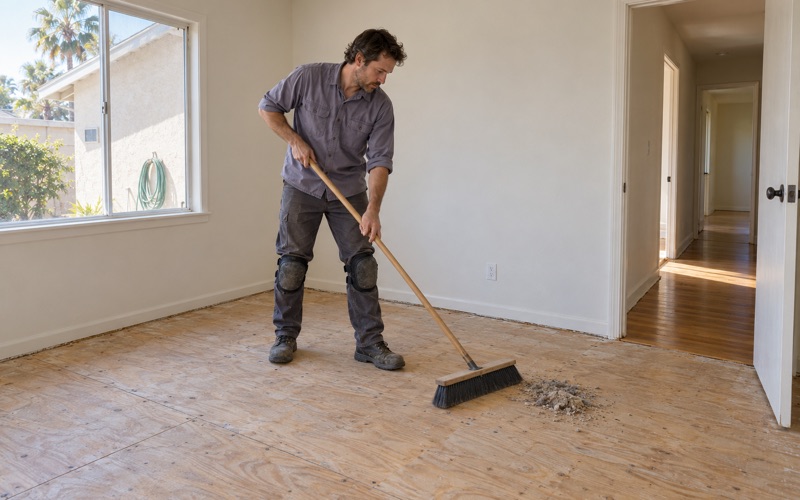
Lakewood Wood Flooring has spent more than 20 years on wood flooring in Compton and nearby, and a good share of our calls here come from owners who rent out a house rather than live in it. The timing on those jobs is different. A unit sits empty between one lease and the next, every week without rent costs money, and the floor is often the item that has to be finished before anything else can move.
We plan those turnovers around the date the house needs to be ready, not around our own calendar. That means walking the rooms, deciding which boards can be repaired and which areas need a full sand, and handing the owner a line-by-line written estimate before any material is ordered. It also means a written cure schedule, so the owner knows exactly when a new tenant can walk across a freshly coated floor.
Most of the rentals we see are older houses carrying several decades of patches, coverings and finishes. That history shapes almost every decision below, from what gets scraped to how much sanding a floor can take.
Compton’s Own Housing Authority and Its Rental Houses
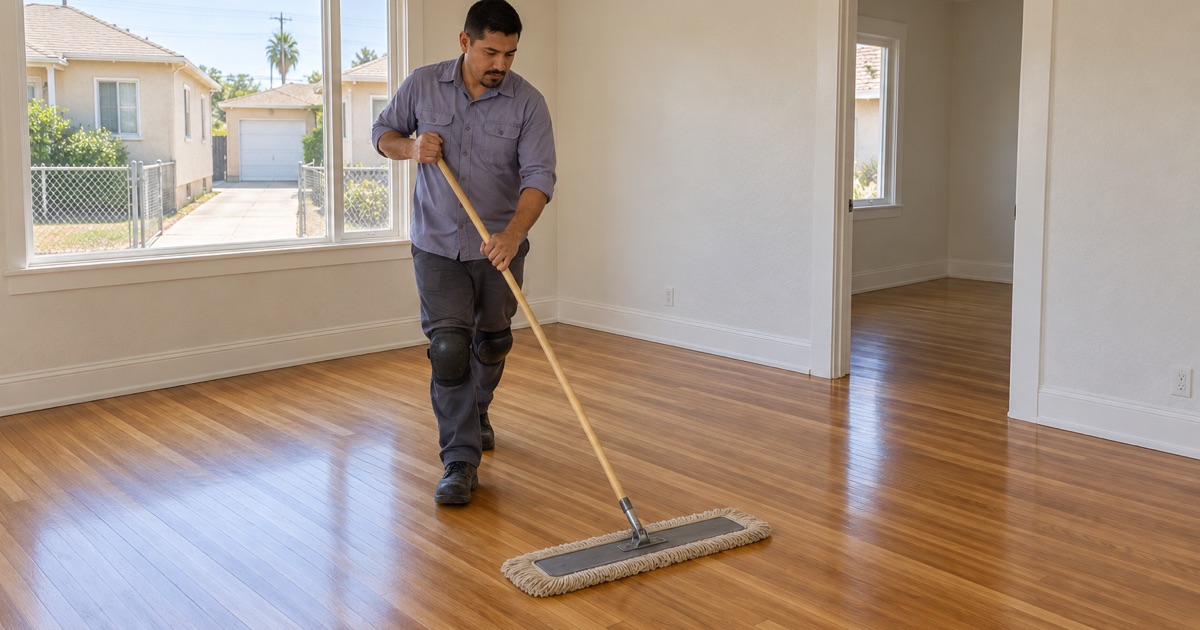
Compton runs its own public housing agency rather than relying entirely on the county. HUD’s contact listing for California shows the City of Compton Housing Authority under code CA071, typed as a Section 8 agency, at 700 N. Bullis Road. The Los Angeles County Development Authority is a separate agency, listed as CA002 and based in Alhambra, so a Compton landlord working with vouchers is usually dealing with the city’s own office.
A secondary listing puts the Compton authority’s program at about 803 Housing Choice Vouchers and no public housing units. That shape matters for floors: with no public housing buildings of its own, the program depends on private owners renting out their houses and apartments. The same listing shows the voucher waiting list closed since it last opened September 25-28, 2017, with preferences that have included Compton residents and workers, veterans, and elderly and disabled applicants.
A City Where Many Renters Live in Houses
Compton has 10,467 renter households, 43.6 percent of its occupied units. Of those, 4,010 rent a detached house, which is 38.3 percent of all renters. That is a large pool of single-family rentals, and many belong to owners who hold one or two houses rather than a portfolio.
Those owners rarely keep a flooring crew on call. When a tenant moves out, they are often sorting out the floor, the paint and the fixtures at the same time while trying to keep the vacancy short. We work to fit into that sequence rather than hold it up.
What We Do and Do Not Say About Inspections
A unit rented to a voucher holder is inspected by the authority before the tenant moves in and periodically after that. We do not state the authority’s inspection standard, and we do not tell owners whether a floor will pass; that call belongs to the inspector, and the owner should ask the authority directly at (310) 605-3080. HUD has also moved the voucher programs’ NSPIRE compliance date to February 1, 2027, which is one more reason to confirm current requirements with the office rather than rely on what a neighbor heard.
What we can do is leave the floor sound, clean and finished, and document the work in writing. The owner then has a record of what was done, in which rooms and on which dates.
Looking for wood-flooring closer to Lynwood? See Lynwood Wood-Flooring.
Floor Work Between Tenants
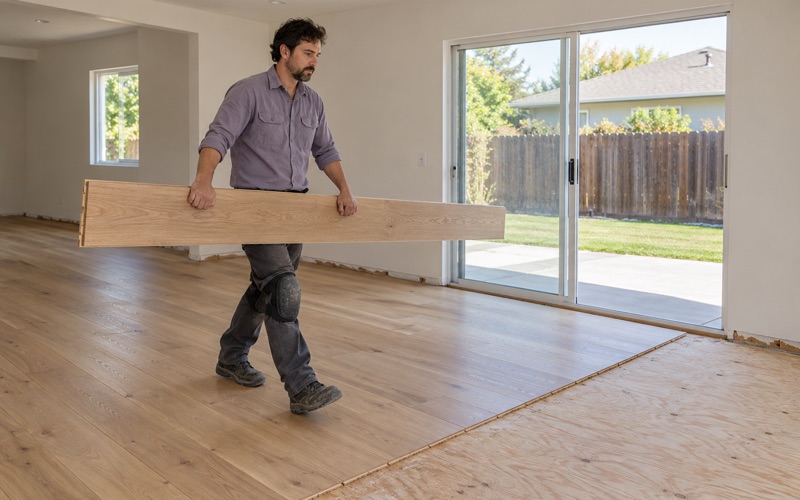
Turnover is the one window when a rental floor is fully open. Furniture is gone, rooms can be closed off, and nobody needs to cross wet finish to reach a bathroom. We try to use that window for everything the floor needs, so the next repair does not have to happen with a family living in the house.
Repair or Refinish
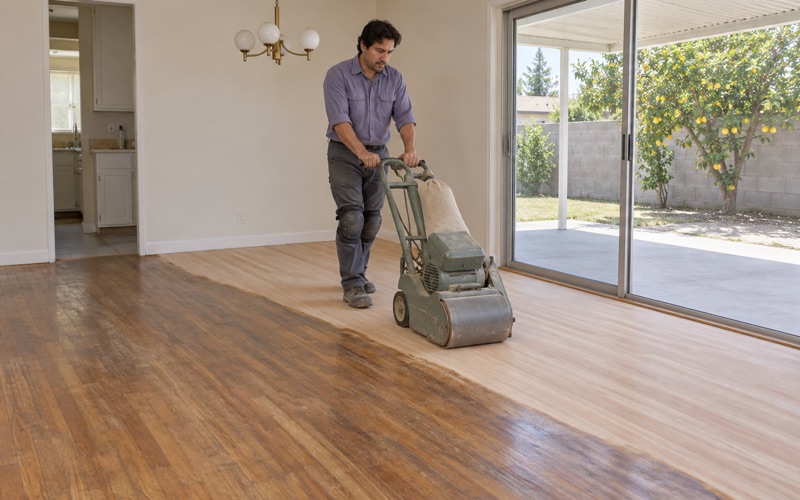
The first question on any turnover is whether the floor needs a full sand, a screen and recoat, or targeted repairs. Worn finish in traffic lanes over otherwise sound wood can often be handled with a screen and recoat, which is faster and leaves more wear layer for later. Deep scratches, gray water marks, pet urine stains and peeling polyurethane usually call for sanding down to bare wood.
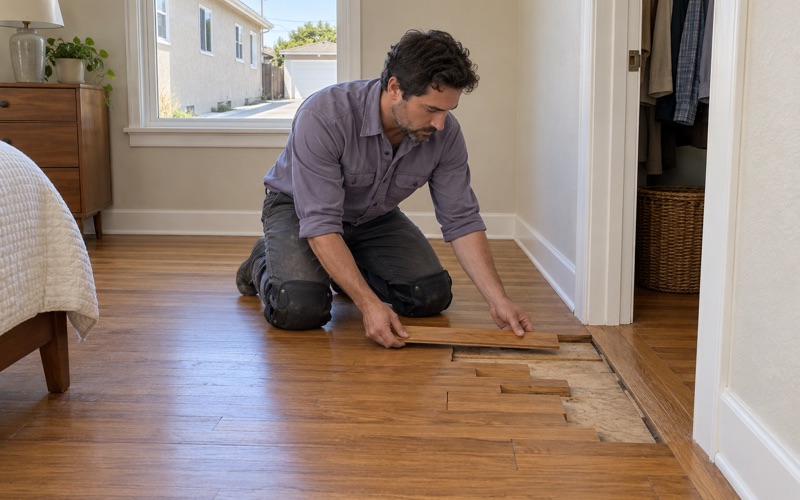
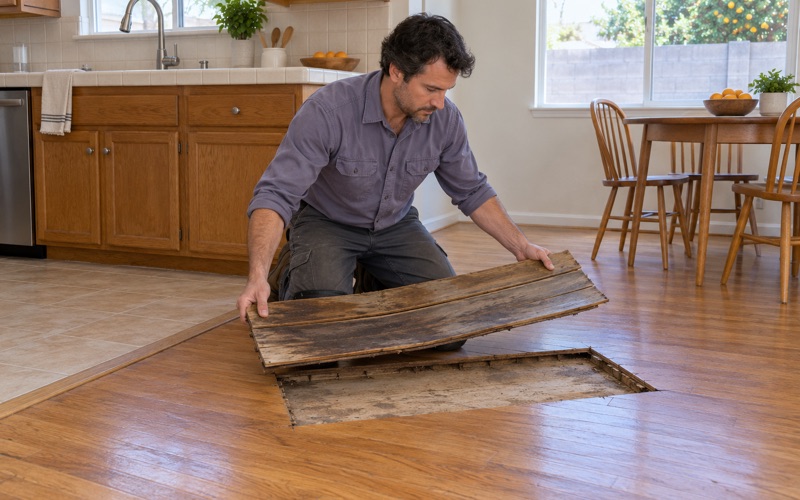
Damaged boards are a separate decision. Where a few boards are split, stained black or cupped from a leak, we cut them out and weave in new ones so the repair blends with the surrounding floor rather than showing as a patch. If cupping or buckling points to water, we trace the source first, whether a supply line leak, a water heater or an aging pipe, because refinishing over an active leak only resets the clock.
Moisture and Soft Spots Before Finish
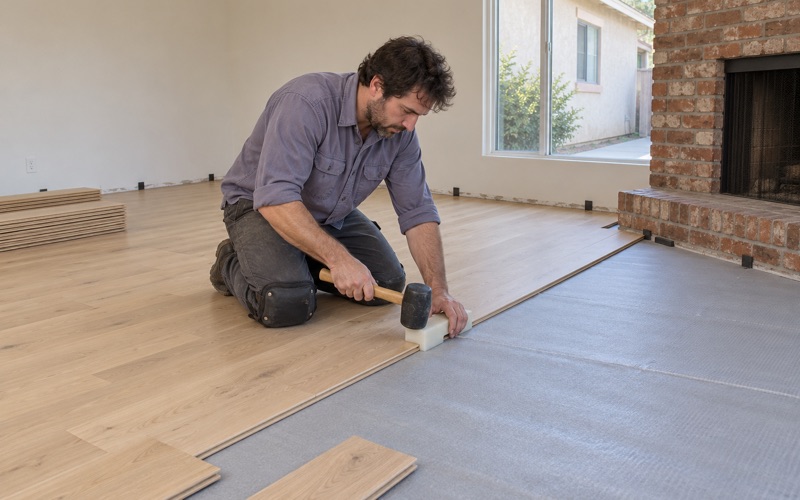
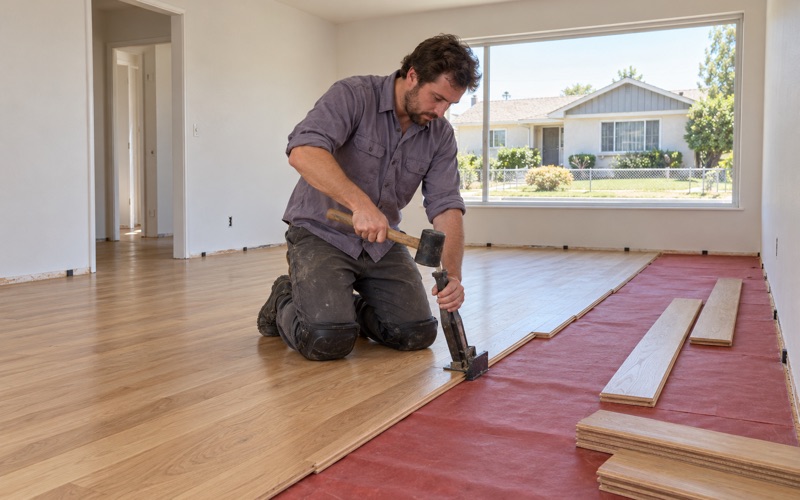
We take moisture content readings with a wood moisture meter before any sanding or board replacement, and we write the numbers down. New boards need acclimation so they reach a moisture content close to the existing floor before they go in. Skipping that step is how a fresh repair opens board gaps a few months into the next lease.
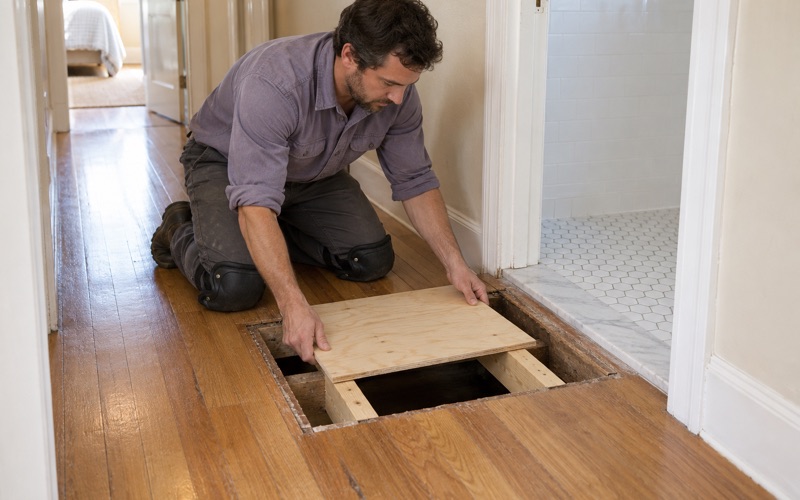
Where a floor feels soft or bouncy, we look at the subfloor and floor joists before pricing a finish. If the problem is structural rather than a flooring job, we tell the owner and refer it out instead of covering it with new coating.
Choosing a Finish for a Rental
Rental floors take hard, steady use, so we lean toward durable finishes that recoat easily at the next turnover. Waterborne polyurethane dries fast and holds its color, which helps when the gap between tenants is short. Oil-modified polyurethane builds a thicker film but cures more slowly and ambers over time.
Every product we apply is legal in the South Coast air basin under SCAQMD Rule 1113 and its 275 g/L limit for wood coatings. We also think about sheen level: a satin or matte finish hides the fine scratches of everyday living far better than gloss, and the floor looks cared for longer between refinishes.
Planning Around an Inspection Date
When an owner already has an inspection on the calendar, we plan backward from that date. The finish needs time to cure before furniture, appliances or heavy foot traffic come back into a room, and that time depends on the product and the weather. Our written cure schedule lists each room, the day the last coat goes on, and the days it can take light use and full use.
The house may also be shown to prospective tenants while work is under way. Rooms under fresh coating stay closed and marked, and we tell the owner ahead of time which days a showing would need to skip which rooms.
Building in a Buffer
We recommend finishing floor work several days before an inspection rather than the evening before. That leaves room to touch up a missed spot, reinstall shoe molding, set reducer strips at doorways and clean up dust before anyone walks through. It also gives the owner time to finish paint and fixture work without stepping on fresh coating.
If a date is too close for a full sand and cure, we say so. Sometimes the honest answer is targeted board repairs and a screen and recoat now, with a full refinish scheduled at the next vacancy.
Keeping Records the Owner Can Use
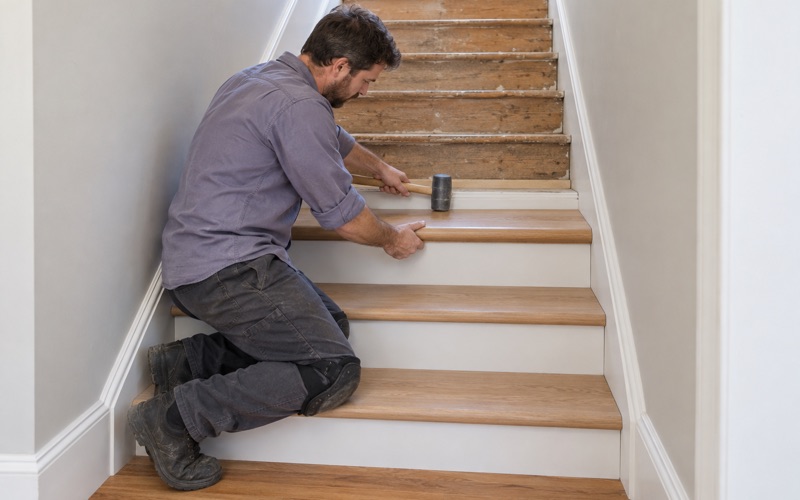
Every job ends with the written estimate, the moisture readings and a short record of what was done in each room. Owners keep those papers for their own files and for security deposit questions under Civil Code 1950.5, when they compare a floor’s condition from one tenancy to the next. Stairs are priced per tread and riser on the estimate rather than folded into a square-foot number, so the owner can see exactly where the money goes.
Refinishing Floors in 1940s and 1950s Rental Houses
Compton’s housing is older than much of the region’s. Of its 25,039 housing units, 58.6 percent predate 1960, and the 1950s are the peak building decade at 28.5 percent of units. A detached rental house here is very likely one of those postwar homes, with decades of coverings, patches and finishes layered on the floor.
What an Older Floor Can Take
A wood floor that has been sanded several times has less wood left above the tongue. Before we sand, we lift a floor register or check a threshold to see how much wear layer remains. If the boards are thin, we use a gentler grit sequence or recommend a screen and recoat instead of risking exposed tongues.
Older rentals often carry mismatched repairs from past turnovers, such as a different species patched in near a kitchen or a room where boards run the other way. We match species and width where we can and weave new boards into the old run, so the floor reads as one surface again.
Coverings, Asbestos and Lead
Many older houses have linoleum, rubber floor tile or 9x9 tile over some of the wood, often set in black mastic. We treat those materials as a possible asbestos question and recommend an asbestos survey before anything is scraped or sanded. Asbestos removal in the South Coast air basin falls under SCAQMD Rule 1403, and it is not something to discover halfway through a turnover.
Almost every house in this age range was built before 1978, so we follow lead-safe work practices under the EPA Renovation, Repair and Painting rule. Sanding can raise lead dust from old paint on baseboards and trim, so we contain the work area and use a dustless sanding system, with an edger and orbital sander for close work. That matters in any rental, and it matters most when the next household may include young children.
- 20+ Years in Wood Flooring
- Line-by-Line Written Estimates
- Lead-Safe Sanding on Pre-1978 Homes