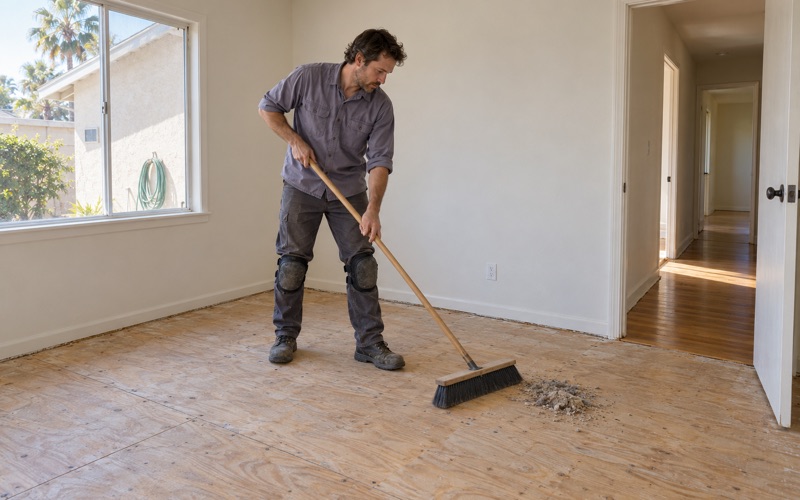
Lakewood Wood Flooring brings more than 20 years of wood-flooring work to Cypress, and this page is about the problem a flat, channel-drained city puts in front of a hardwood floor: storm water. When rain gets into a house, the questions that follow are practical ones about what to do first, what to measure and whether the boards can be saved. We answer them here in the order they usually come up.
Our work on a wet floor starts with the source, not the boards. A floor that cups after a storm may have taken water through a door threshold, a wall base or a supply line that happened to fail the same week, and the repair plan changes with each one. We photograph what we find and write down moisture readings, so an adjuster, a landlord or a buyer sees the same record we do.
Most of what follows applies whether the room holds solid oak, engineered planks or a floor nobody has seen since carpet went over it. Where a board can be dried and kept, we say so. Where it cannot, we explain why before anything is torn out.
Storm Water, Pump Stations and the Carbon Creek Channel
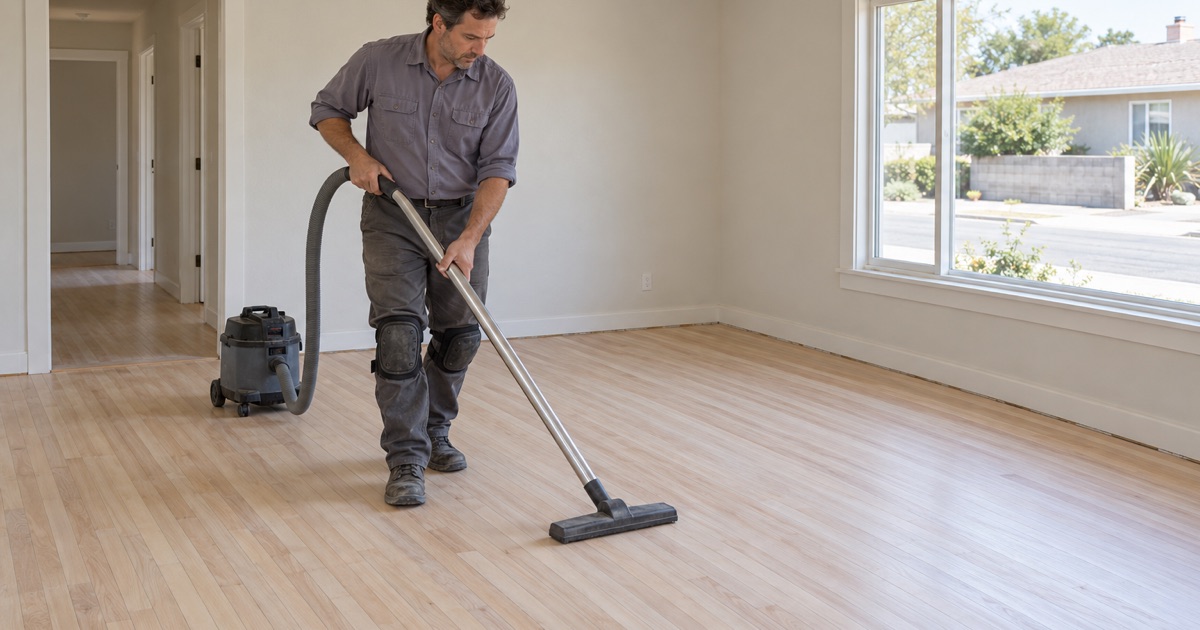
Rain in a flat city has few places to go on its own. Cypress relies on storm drains that carry runoff into flood control channels, including the Orange County Flood Control District’s Carbon Creek Channel. In one part of the city, gravity is not enough, and a pump does the lifting.
The Myra Avenue pump station
On Myra Avenue, just south of the Carbon Creek Channel and bordered by single-family homes, the City of Cypress operates Myra Pump Station No. 1. It lifts storm water from an approximately 86-acre developed watershed into the channel. The station was built in 1961 and designed for 25-year storm protection at a capacity of 90 cubic feet per second.
In a Notice of Exemption signed July 8, 2026, the city states that updated hydrological standards require 133 cubic feet per second, leaving the existing station inadequate and “contributing to drainage inefficiencies and upstream flooding.” The proposed fix is a new pump station on the adjoining city parcel, with storm-drain improvements to carry flows to the channel.
What the flood map shows near the station
FEMA’s current National Flood Hazard Layer, read in a small area around the station, shows Zone A along a narrow strip that follows the channel and a shaded 0.2 percent annual chance flood zone beside it. That is a reading of the map near one public facility, not a statement about any address. For a question about a particular property, the map itself and the city are the sources to check.
Why a floor installer cares
The city’s General Plan EIR says the 100-year flood is contained within the Carbon Creek and Bolsa Chica storm drain channels, while a 500-year flood could spread across the whole city. For a wood floor, the lesson is modest but real. In a flat city, water that cannot leave the street quickly has more time to find a door, a low patio or the base of a wall, so we plan work here assuming a heavy storm is part of the floor’s future.
Cypress sits in the National Weather Service’s Orange County Inland forecast zone, CAZ554, so storm watches and warnings for the city are issued under that zone name. A watch there is a reasonable cue to clear patio drains, lift rugs away from sliding doors and look at the threshold once the rain stops.
Looking for wood-flooring closer to Long Beach? See Long Beach Wood-Flooring.
How Rain Water Gets Into a House
Storm water rarely reaches a wood floor as a sheet coming under the front door. It usually arrives slowly and at the edges, and the floor shows the pattern before anyone sees standing water. Reading that pattern is how we find the entry point.
Doors, sliders and patios
Sliding doors to a back patio are the path we trace most often. If the patio slopes toward the house or its drain is clogged with leaves, rain collects against the threshold and wicks under it, and the first sign is a row of cupped boards along the door. Cupping means the bottoms of the boards took on more moisture than the tops, which points us straight to the wet edge.
A threshold that has lost its seal or a door sweep worn down to nothing makes the problem worse with every storm. We note those in our report, since fixing them is often the cheapest part of keeping a repaired floor dry.
Walls, planters and concrete
Water can also move through the bottom of an exterior wall when soil or a planter bed sits higher than the floor inside. On concrete, moisture can rise through the slab after a long wet stretch, and that damage looks different from a spill: it is spread out and slow, showing as gaps, cupping or a finish that turns cloudy. On a framed floor, damp air or water below the boards raises humidity against their undersides and can bring on the same cupping from underneath.
Leaks that arrive with the storm
Not every wet floor after rain is rain. A roof leak can run down inside a wall and appear at the baseboard, and a water heater or supply line can fail the same week by coincidence. We check each path, because drying a floor while the source keeps feeding it only buys a second repair.
The First Days After a Wet Floor
What happens in the first two or three days decides more about a wet wood floor than anything after. Speed matters, and so does keeping the damage easy to document. Here is how we handle that window and how we judge the floor once it is past.
Stop the water and get it off the floor
Once the source is stopped, standing water needs to come off the surface right away, and rugs and furniture need to come off the boards. Wet carpet or pad resting on wood holds water against it, so it gets pulled back. Fans and dehumidifiers help, but blasting heat across a soaked floor dries the top faster than the bottom and can check or split the boards.
Measure instead of guessing
We take readings with a wood moisture meter across the wet area and in a dry room of the same house, which gives a baseline for that floor’s normal moisture content. Where the wood sits over concrete, the slab gets its own test, either an ASTM F2170 in-situ relative humidity test or a calcium chloride test depending on the job. Every reading goes into a dated log, so drying is measured rather than judged by eye.
Drying is finished when the readings in the wet area come back within range of the baseline room, not when the surface feels dry to the hand. That can take days or weeks, depending on how long the water sat and what lies under the wood. Refinishing or reinstalling before that point seals moisture in, and the floor moves again after the job is paid for.
Document for the claim
Before anything is removed, we photograph the damage, the meter readings and the likely source. When an insurance claim is involved, our estimate is written line by line, the format the California Department of Insurance tells homeowners to ask for. Whether a policy covers storm water is between the owner and the insurer, and we leave that answer to them.
How we judge what can be kept
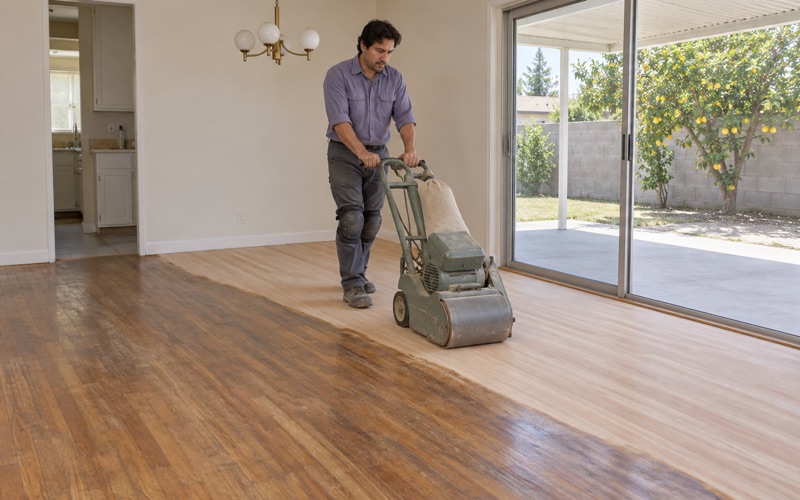
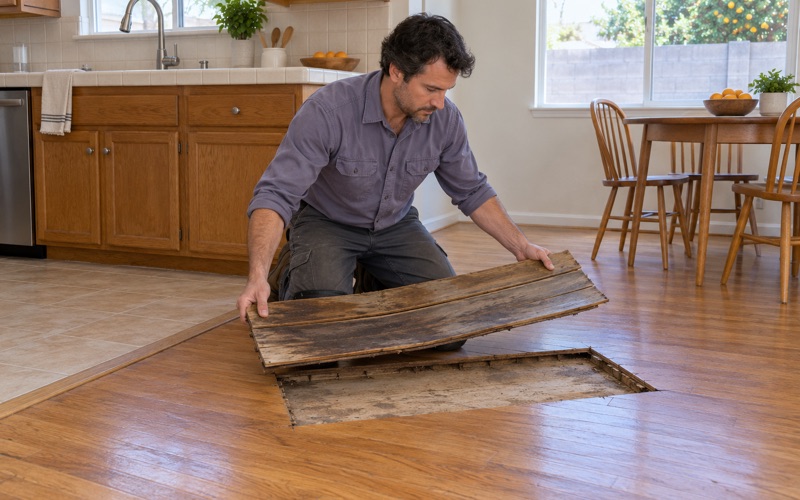
Mild cupping often flattens as a floor dries back to its baseline, and those boards can then be sanded and refinished. Boards that buckled off the subfloor, turned black at the joints or delaminated in an engineered plank usually cannot be saved. We wait for the readings before sanding, because sanding a cupped floor too early leaves it crowned once the bottoms dry out.
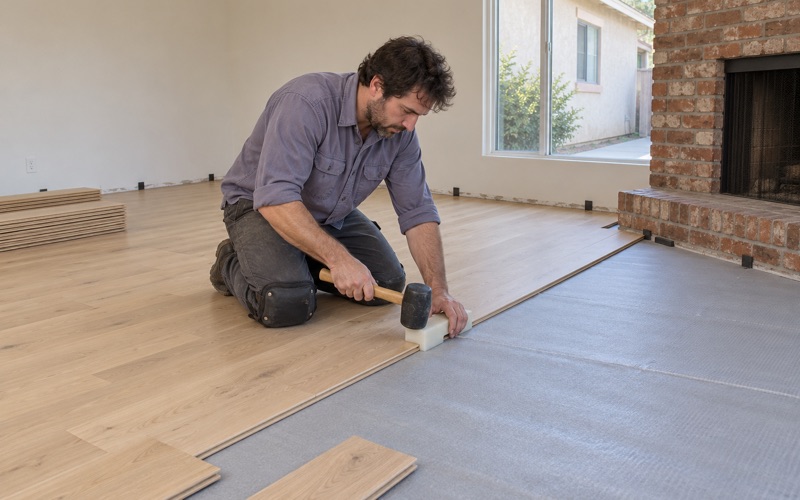
Glue-down engineered floors over concrete need a closer look, because water can break the bond between plank and slab even when the surface looks flat. We tap across the area and listen for hollow spots, then check the adhesive under a lifted board before calling the floor sound.
Planning Floor Work in Cypress
Cypress was incorporated in 1956 as Dairy City, and its housing followed quickly once the dairies sold. About 67.6 percent of its housing units were built in the 1960s and 1970s. That history shapes what we find when a wet floor is opened up.
What sits under older flooring
Most floors we open here have had other flooring laid over them at some point. Sheet vinyl, linoleum or 9x9 tile found under carpet is treated as a possible asbestos question before any scraping starts, and black mastic gets the same caution. Homes built before 1978 get lead-safe work practices under the EPA Renovation, Repair and Painting rule, since sanding old finishes and trim can put lead dust in the air.
Repairing instead of replacing
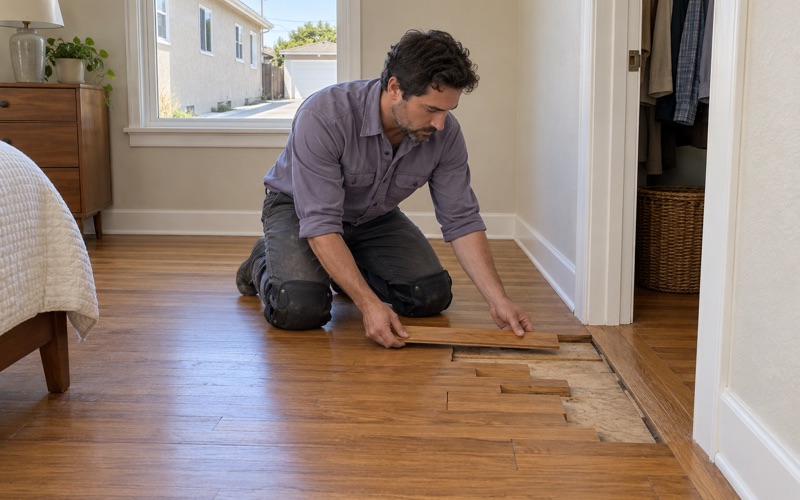
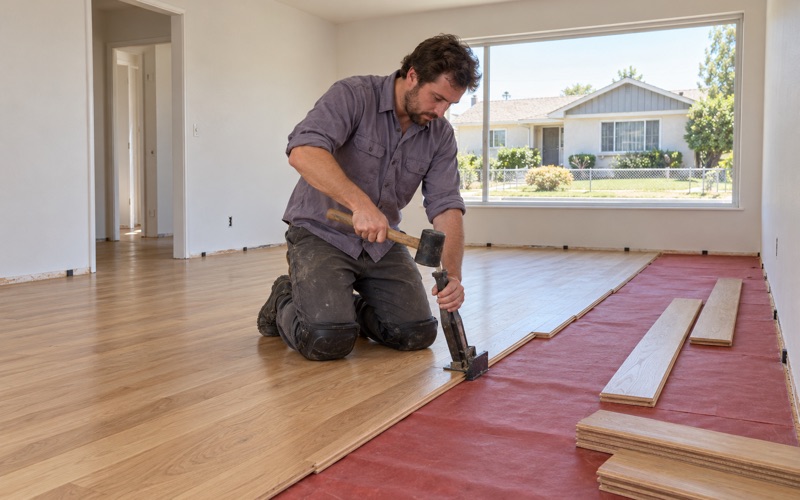
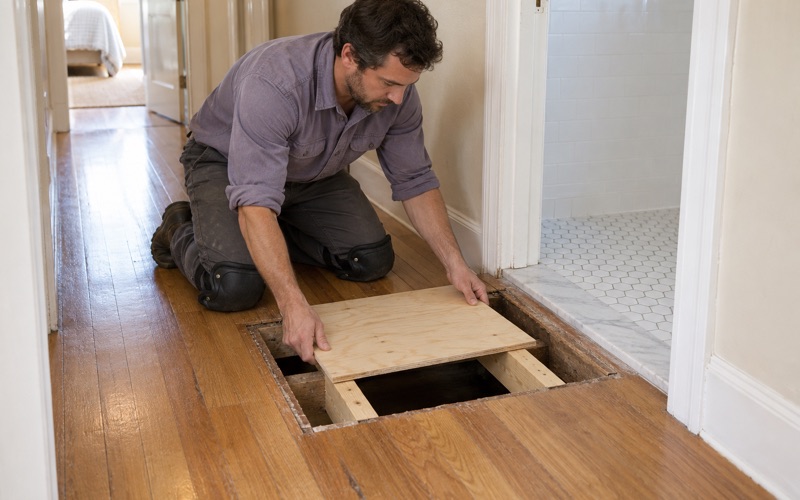
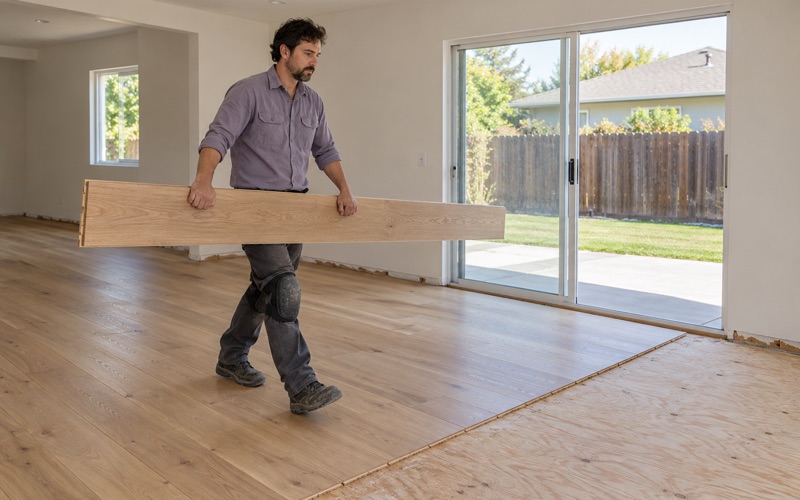
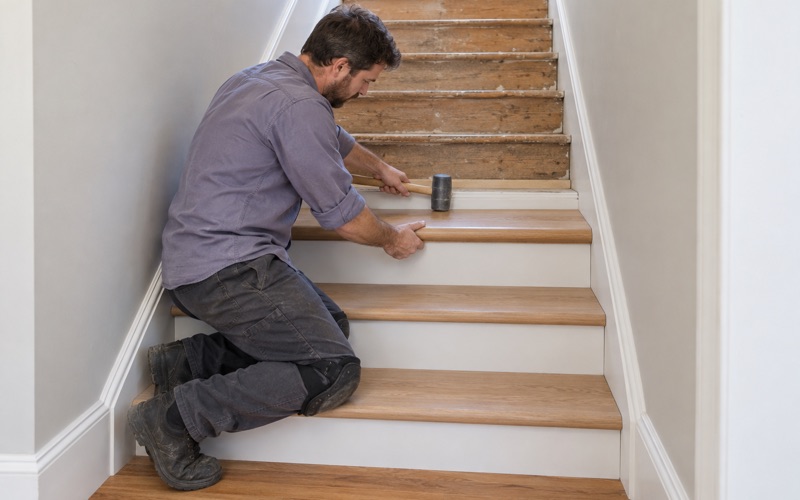
When only the boards near a door or wall took water, we often cut out the damaged run and weave new boards into the existing floor so the repair does not read as a patch. Replacement stock is acclimated and checked with the meter before it goes down, so its moisture content matches the floor around it. Stairs are priced per tread and riser rather than folded into a square-foot figure.
In condos and townhomes, association rules can limit which floors go in and how they are installed. We ask for those rules before ordering material, so a replacement floor is not rejected after it arrives.
Finishes, hours and cure times
The finishes we apply meet the 275 g/L VOC limit for wood coatings under South Coast AQMD Rule 1113. We schedule work inside permitted construction hours and hand every household a written cure schedule showing when each room can take foot traffic and furniture again. Questions about permits or association approval go to the City of Cypress Community Development Department or the HOA, and we tell owners that plainly rather than guessing.
- 20+ Years in Wood Flooring
- Line-by-Line Written Estimates
- Lead-Safe Sanding on Pre-1978 Homes