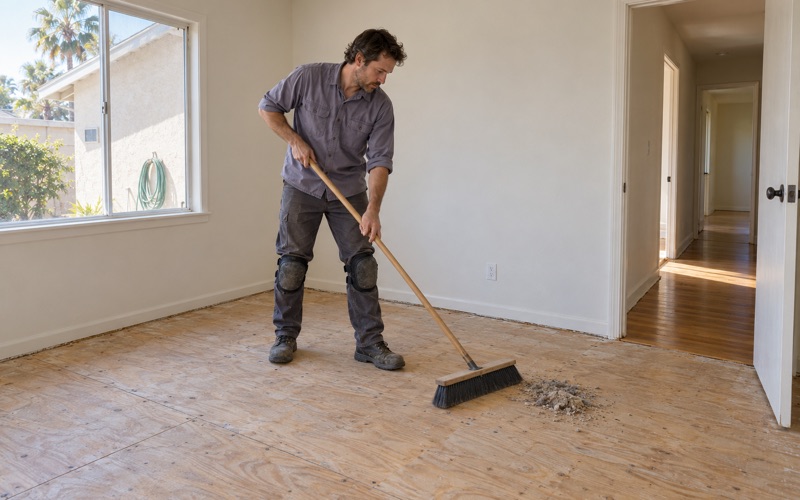
Lakewood Wood Flooring has spent more than 20 years on wood flooring in Downey and the cities around it, and a large share of the floors we sand, repair or replace here sit inside homes that someone rents. That changes the job before a single board is touched. The first questions are who lives there, whether they stay during the work, and how many days each room will be out of use.
We answer those questions on paper. Every estimate we hand over lists the work line by line, and every schedule comes with a written cure plan showing when each room can take foot traffic again and when furniture can go back. An owner can pass that plan to a tenant, and the tenant can see exactly what the week will look like.
Before any of that, we measure. Moisture content in the wood and in any concrete is read with a meter and written down before material is ordered, and old sheet goods or tile are treated as a possible asbestos question before anything is scraped or sanded.
Downey’s Choice and the State Law Behind It

A Council Vote in 2021
In January 2021, Councilmember Alvarez asked city staff to explore stricter rent controls and tenant protections. The council took up the item in February and spent about four hours on it, well past midnight. The Downey Patriot reported that the measure was struck down unanimously, with Alvarez voting against her own proposal.
The result is that Downey renters are covered by state-law rent caps rather than a stricter local measure. When an owner asks us about doing floor work in an occupied unit, the rules that frame the conversation come from Sacramento, not from City Hall.
Where the Housing Division Sends People
The City of Downey Housing Division publishes a page on AB 1482, the California Tenant Protection Act of 2019, for both renters and owners. It lists demolition or a substantial remodel of the property that meets the requirements of state law as a permissible no-fault reason, and it states that relocation assistance is required for covered no-fault evictions. The same page flags Senate Bill 567, effective April 1, 2024, which strengthened the requirements for owner move-in and substantial remodel evictions.
The statute underneath is Civil Code 1946.2, amended again by AB 1529 effective January 1, 2026. Under it, the relocation assistance or rent waiver equals one month of the tenant’s rent in effect when the owner issued the notice. We are a flooring contractor, not a law office, so we quote the text and leave the reading of it to the city or a lawyer.
A City Split Nearly in Half
Downey’s housing divides almost evenly. Of the city’s 34,876 occupied units, 51.1 percent are owner-occupied and 48.9 percent are renter-occupied, so close to half the floors we look at here belong to a household that does not own the home. A refinish in one of those homes gets scheduled around a person who lives there, under rules written at the state level.
Looking for wood-flooring closer to Buena Park? See Buena Park Wood-Flooring.
Cosmetic Work Versus a Substantial Remodel
The state definition is narrow, and it is worth reading closely. A substantial remodel means replacing or substantially modifying a structural, electrical, plumbing or mechanical system in work that needs a permit from a governmental agency, or abating hazardous materials such as lead-based paint, mold or asbestos. Either way, the work has to be something that cannot reasonably be done safely with the tenant living there, and it has to require the tenant to vacate for at least 30 consecutive days.
The statute then spells out what falls outside that definition. In its words, cosmetic improvements alone, including painting, decorating, and minor repairs, or other work that can be performed safely without having the residential real property vacated, do not qualify as substantial remodel.
How We Describe a Floor Job on Paper
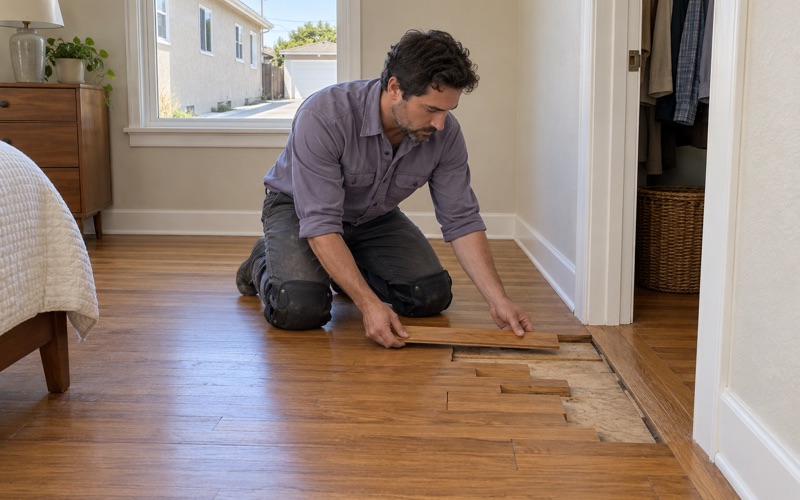
Most of the floor work we do in a Downey rental is short and room by room. A screen and recoat is a day plus cure time, a full sand and refinish runs a few days, and a board replacement or weave-in repair is often an afternoon. Those jobs are planned so the household keeps using the rest of the home.
We never tell an owner how a particular job measures against the statute. What we provide is a written scope, a day count for each room, and our moisture readings, so the owner, the tenant and any lawyer involved are all working from the same facts.
When Hazardous Materials Turn Up
Downey’s housing is old. Of its 35,919 units, 38.6 percent were built in the 1950s and 82.9 percent before 1980. Linoleum, rubber floor tile and 9x9 asbestos floor tile, often set in black mastic, are common finds under carpet in homes of that age.
Because the state definition names abatement of asbestos and lead-based paint, a find like that matters to more than the floor. We stop, recommend an asbestos survey by a qualified firm, and put what we saw in writing before anyone decides the next step. On pre-1978 housing we follow lead-safe work practices under the EPA Renovation, Repair and Painting rule, since sanding near a painted threshold or baseboard can raise lead dust.
Floor Work With a Tenant at Home
Sequencing Rooms
When a tenant stays, we split the floor into zones that close one at a time. Bedrooms usually go first while the household lives in the front room, and then the order flips. The written schedule shows which door closes on which morning and when it opens again.
Each coat has its own window. The cure plan lists when a room can take socks only, when shoes are fine, and when rugs and heavy furniture can return, which spares the tenant from guessing and the owner from a scuffed finish.
Hallways and kitchens take the most planning because they connect everything else. We often finish those last, on a day agreed with the owner and tenant, and keep a cured path to the bathroom and the exits.
Apartments and Detached Rentals
The mix of rentals in Downey shapes the job. About 61.5 percent of the city’s renter households live in buildings of five or more units, where a sanding day also involves shared hallways, parking for the equipment and neighbors on the other side of a wall. Another 3,665 renter households rent a detached house, which usually gives us more room to stage and a simpler path for the dust collection hose.
In either setting, loud work stays inside permitted construction hours, and the owner confirms access days with the tenant ahead of time. We work to the owner’s notice, not around it.
Dust, Odor and Finish Choice
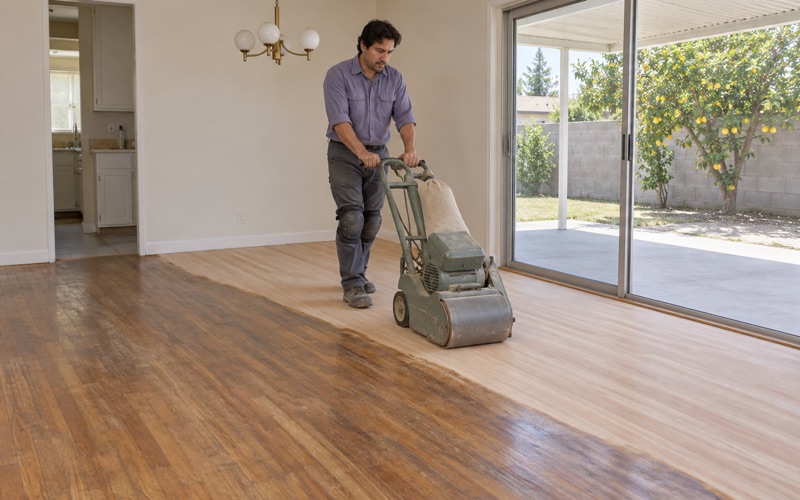
We sand with a dustless sanding system connected to the drum sander, edger and orbital sander, and we set up containment at the doorway of the room being worked. That keeps fine dust out of the rooms where someone is still sleeping.
Finish choice matters more in an occupied home. Everything we apply is legal in the South Coast air basin under SCAQMD Rule 1113, which caps wood coatings at 275 g/L of VOC. A waterborne polyurethane is usually our first suggestion when people are living on site, because it dries faster between coats, while oil-modified polyurethane and hardwax oil finishes stay available with their longer cure times written into the plan.
Planning Floors Between Tenancies
The Turnover Window
The simplest time to refinish or replace a floor in a rental is between one lease and the next. With the unit empty, a full sand, stain and three coats can run straight through with no one waiting on cure time. A replacement can include underlayment work without closing rooms in sequence.
We ask owners to call before move-out rather than after. That lets us check for cupping, crowning, board gaps and squeaks, take moisture readings, and order material early enough for proper acclimation, so the floor is not the thing holding up the next lease.
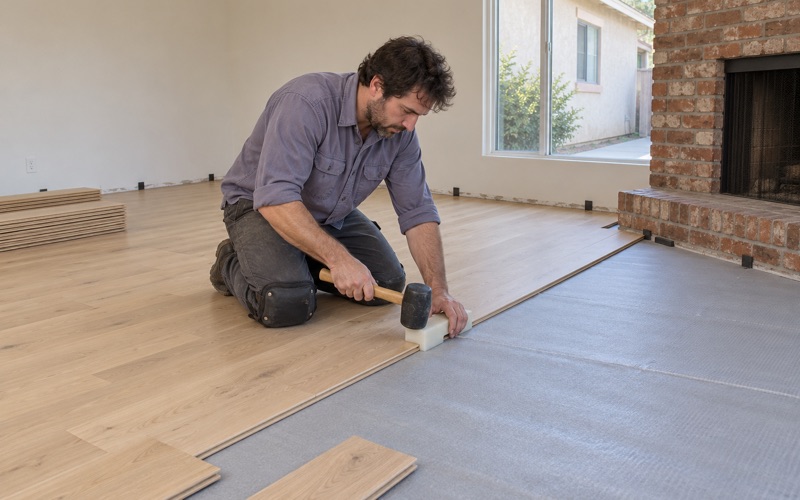
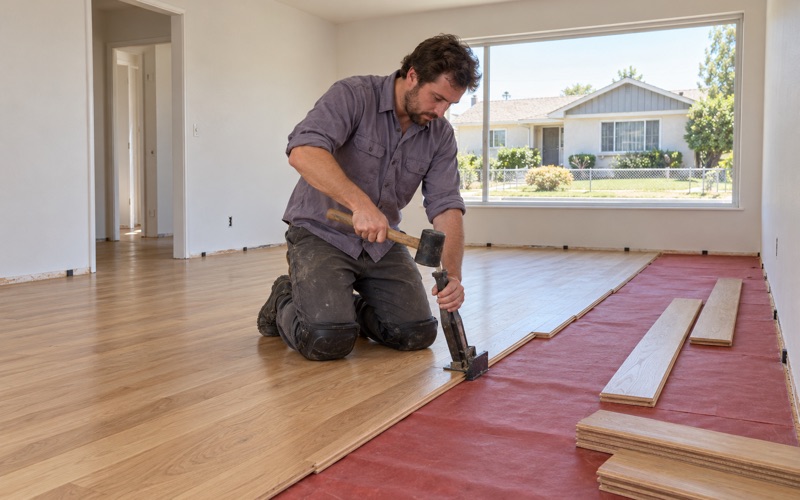
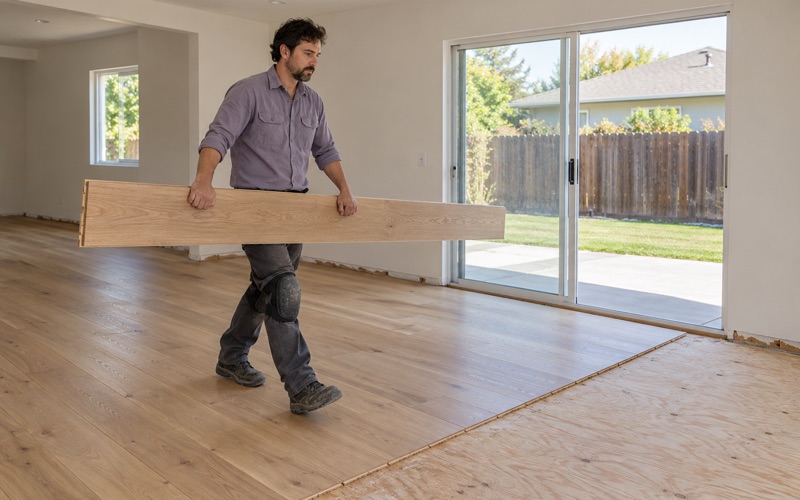
An empty unit also widens the choice of installation method. A nail-down installation over a board subfloor, a glue-down installation over concrete, and a floating installation each carry different prep, noise and drying time, and a vacant week lets us pick the method that suits the floor rather than the one that disrupts a household least. We follow NWFA installation guidelines for expansion gap, fastener spacing and moisture limits either way.
Refinish, Repair or Replace
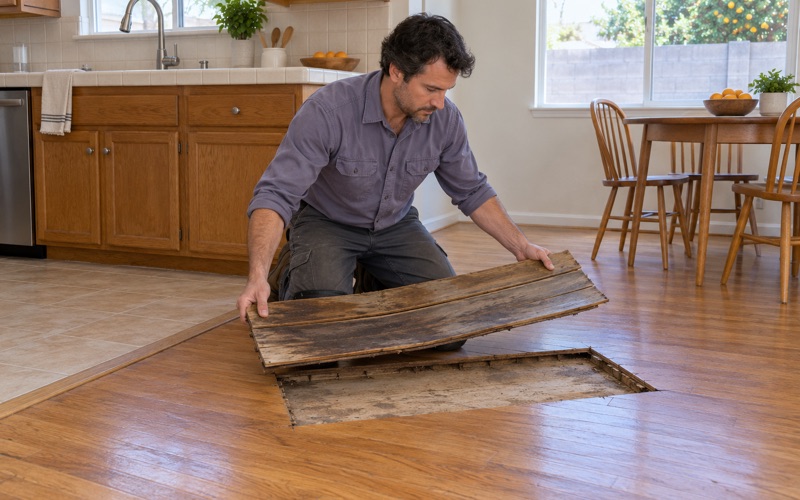
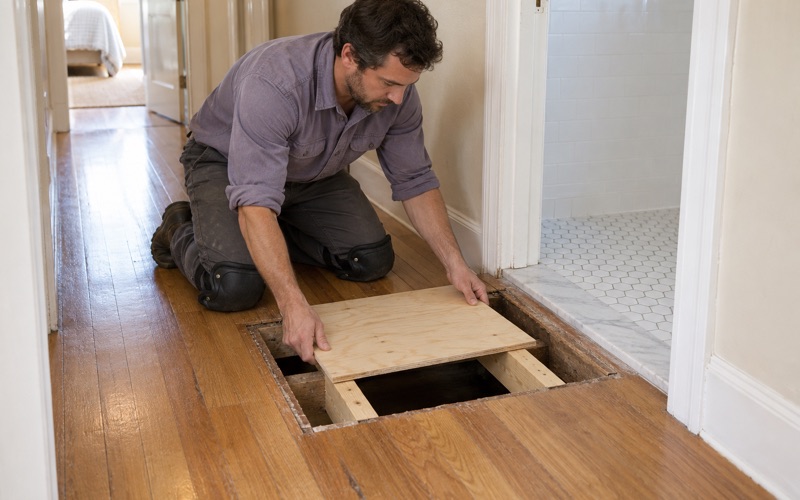
In a house from the 1950s, the first step is lifting a corner of carpet or linoleum to see what sits underneath. We assess any existing wood floor before anyone talks about replacing it, because a sound floor with worn finish is often a sanding job rather than a tear-out. Where a floor is sagging or bouncy, we trace it down to the subfloor and the floor joists before pricing a finish floor, and we refer structural work out when it goes beyond flooring.
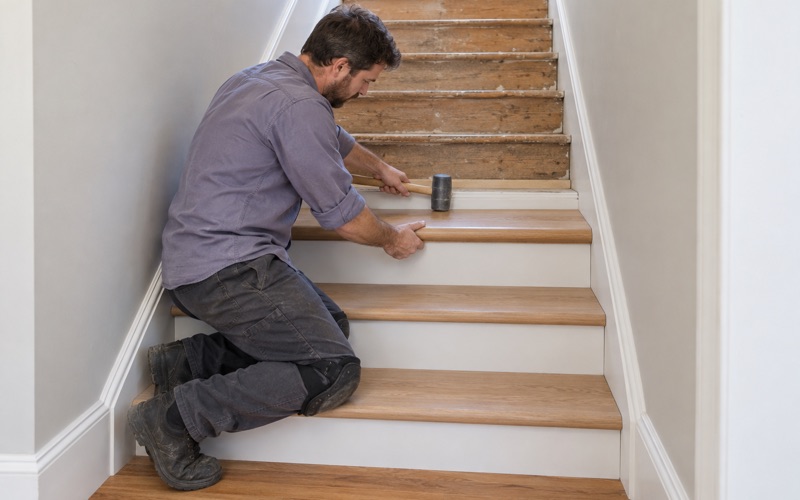
When replacement makes sense, a rental puts durability first. We compare species by Janka hardness rating, with white oak and hickory common choices, and we point owners toward engineered flooring with enough wear layer thickness to be sanded again at a later turnover. Stairs are priced per tread and riser rather than folded into a square-foot number, so an owner can see what the staircase costs on its own.
Documenting Condition
Turnover is also when floor condition gets argued over. Pet urine stains, deep scratches and water damage each have different causes and different fixes, so we photograph each one before work starts. If a supply line leak or water heater leak caused the damage, we trace it to its source and record moisture readings in a form an insurance adjuster can use.
A clear record serves both sides of the lease. The owner has dated photos and readings, and the next tenant moves in on a floor whose condition is written down from the first day.
- 20+ Years in Wood Flooring
- Line-by-Line Written Estimates
- Lead-Safe Sanding on Pre-1978 Homes