Lakewood Wood Flooring has spent more than 20 years on wood-flooring in Norwalk and the surrounding area, and a good share of that time goes to a question owners rarely think to ask: who is actually allowed to do the work in the house? We sand and refinish, repair boards, rebuild stairs and install new floors. Before any of that, we would rather an owner know what to look for in whoever they hire, including us.
This page is written for the person about to bring a floor crew into a Norwalk home. It explains what the city asks of any business working inside its limits, which pieces of paper a homeowner can reasonably ask a contractor to produce, and the point at which an owner doing the job alone takes on the role of builder of record. None of it is complicated, and all of it is easier to settle before a deposit changes hands.
We also cover what we usually find under the carpet in a house of this age, because the paperwork and the floor are connected. A crew that is careless about one is rarely careful about the other.
Norwalk’s Business License Rule
The City of Norwalk puts its rule in one sentence on the Finance Department’s business license page: “In order to conduct, manage, carry on or engage in any business in the City of Norwalk, a valid business License is required.” The requirement sits in the Norwalk Municipal Code at Section 5.08.010. It is a city rule, separate from anything the state asks of a trade, and it applies to a flooring company the same way it applies to a retail shop or a restaurant.
Out-of-town crews are included
The part owners most often miss is that the rule is not limited to companies with an address in Norwalk. The city’s page states that the license covers out-of-town businesses working within city limits, as well as home-based operations. A floor contractor based in another city who takes a job on a Norwalk street is doing business in Norwalk for the length of that job.
That matters because a great deal of residential floor work in this area is done by crews who live and park their trucks somewhere else. Where a company is based says nothing about whether it has registered with the city it is working in. The only way to know is to ask.
A license runs by the calendar year
Norwalk business licenses are valid for one calendar year and expire on December 31 of each year. Renewal is due by January 31, and the city notes that interest and penalties apply when payment comes in after the due date. A license a contractor showed you last spring may not be the license that covers a job starting in February.
For an owner, the practical step is simple. Look at the expiration date on whatever the contractor shows, and if a job runs across the new year, it is fair to ask whether the renewal has gone in. The city’s Business Licensing office is at 12700 Norwalk Blvd., Room 5, and can be reached at (562) 929-5713 with questions about how the rule applies.
Why the rule reaches the permit counter
Norwalk runs its own Building & Safety Division inside Community Development, at (562) 929-5733. The city’s building permit page ties the two offices together: contractors need a City Business License from the Finance Department in order to obtain building permits. A contractor without one cannot pull a permit in Norwalk, whatever else they hold.
We are not saying here which floor jobs go through that division and which do not. That is a question for Building & Safety, asked about the specific scope of work. What the business license rule settles is who can stand at the counter if a permit is part of the job.
Looking for wood-flooring closer to Rossmoor? See Rossmoor Wood-Flooring.
What to Ask a Floor Contractor to Show
A homeowner does not need to become an expert in licensing to hire well. A few documents, requested politely before the work is scheduled, tell you most of what you need. A contractor who has them will not mind being asked, and one who hesitates has told you something useful.
The city business license
Ask to see the Norwalk business license and check the year on it. Given the December 31 expiration, the date is the first thing worth reading. If a contractor says they work in Norwalk all the time but have never registered with the city, that is a gap in their paperwork, not a technicality.
The state pocket license and workers’ compensation
According to excerpts of the city’s own building pages, contractors applying for permits show three things: the city business license, their state pocket license and proof of workers’ compensation coverage. An owner can ask for the same three items even on a job that never goes near the permit counter. The state license is issued by the Contractors State License Board, and wood floor work generally falls under the C-15 flooring and floor covering classification.
Workers’ compensation coverage is the one owners most often skip. If someone on the crew is hurt on a drum sander or carrying boxes of plank up a stair, the question of who covers the injury matters to the household. Asking to see the coverage before the start date costs nothing.
A written scope and estimate
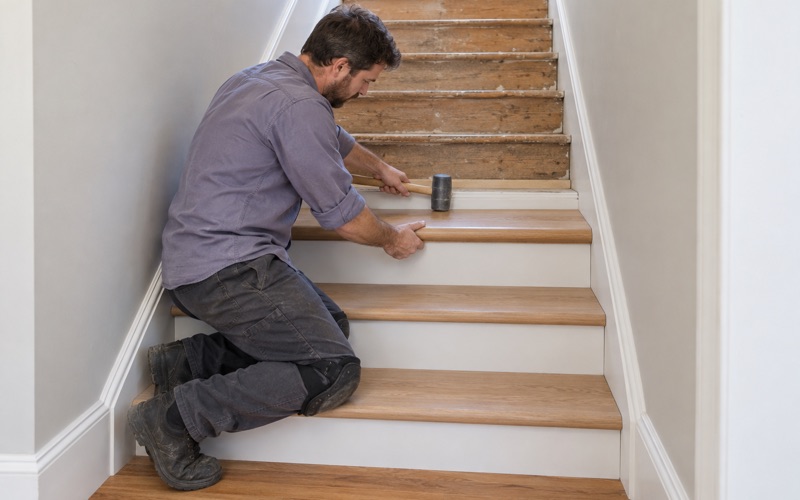
The last document is the estimate itself. Ours is written line by line, which is the format the California Department of Insurance recommends homeowners ask for when a claim is involved, and it is just as useful when no claim exists. Sanding, finish coats, board replacement and each stair tread and riser appear as separate lines rather than one square-foot figure.
A written scope also gives an owner something concrete to bring to Building & Safety if they want to ask whether their particular job needs anything from the city. A description like “remove carpet, sand and apply three coats of waterborne polyurethane in four rooms” is a much clearer question than “redo the floors.”
When the Owner Is the Builder
Some Norwalk homeowners do floor work themselves, or hire help by the day and run the job on their own. That is a legitimate choice, and the city makes room for it. It also changes who carries the responsibility if a permit is involved.
The name on the grant deed
The city’s building permit page states that a “Permit may be issued to the property owner (as shown on the Grant Deed).” The owner presents California identification and signs an Owner Builder Declaration. The permit then belongs to that owner, and the owner is the builder of record for the work it covers.
The grant deed is the controlling document. A relative living in the house, a tenant or a family member who helped with the down payment is not the owner in this sense unless their name is on the deed. Owners who took title through a trust or have recently refinanced should check exactly how the deed reads before assuming they can sign.
What signing the declaration means in practice
Signing as owner-builder means the owner, rather than a contractor, answers to Building & Safety for that work. If the owner then pays a crew to do the labor, the question of licensing and coverage for those workers does not disappear; it simply lands on the owner instead of on a contractor. That is the reason we suggest owners think carefully before signing on behalf of a job someone else will actually perform.
When we are hired, we would rather the scope be clear from the start: what we are doing, what the owner is handling and what, if anything, is going to the city. That conversation happens before a board is pulled.
Floor Jobs in Norwalk’s 1950s Houses
Norwalk was incorporated in 1957, and much of its housing was already standing by then. Census figures show 47.0 percent of the city’s housing units were built in the 1950s, and 73.3 percent of all units are one-unit detached houses. With 68.3 percent of occupied units owner-occupied, most floor decisions here are being made by the people who live on those floors.
What a floor of this age can hide
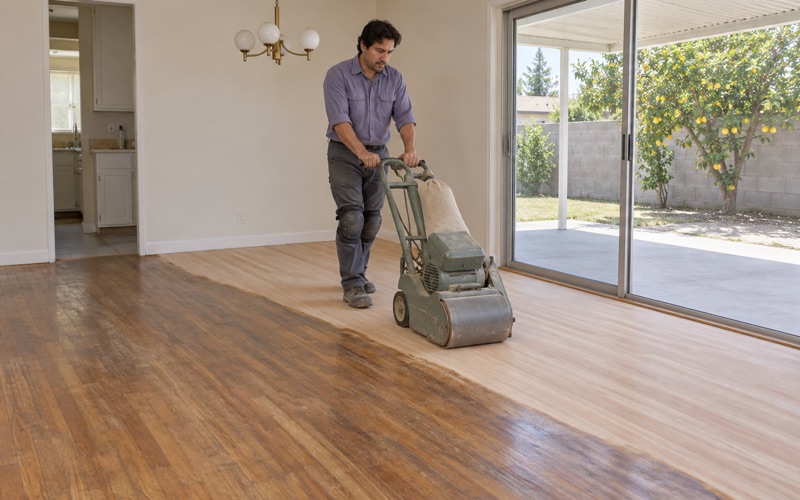
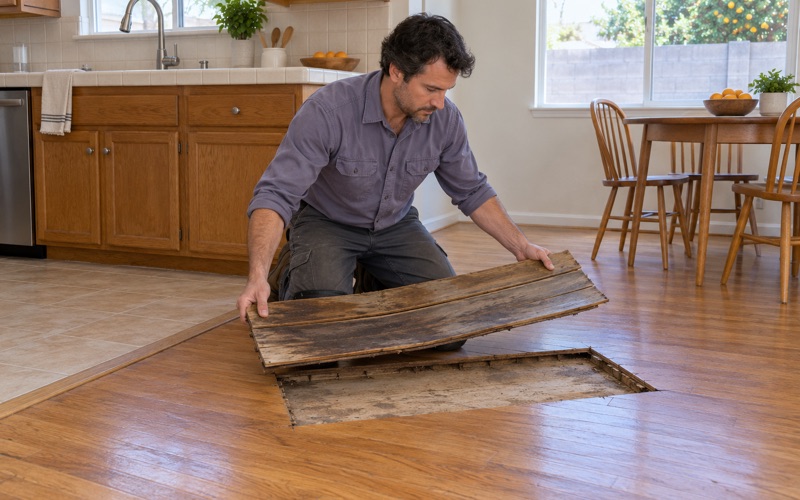
A 1950s house has usually been through several rounds of flooring. Wood may sit under wall-to-wall carpet, under sheet linoleum or under a layer of tile laid decades later. We do not assume what species or condition the wood is until we have lifted a corner and looked, and we do not price a replacement until we know whether the existing floor can be sanded.
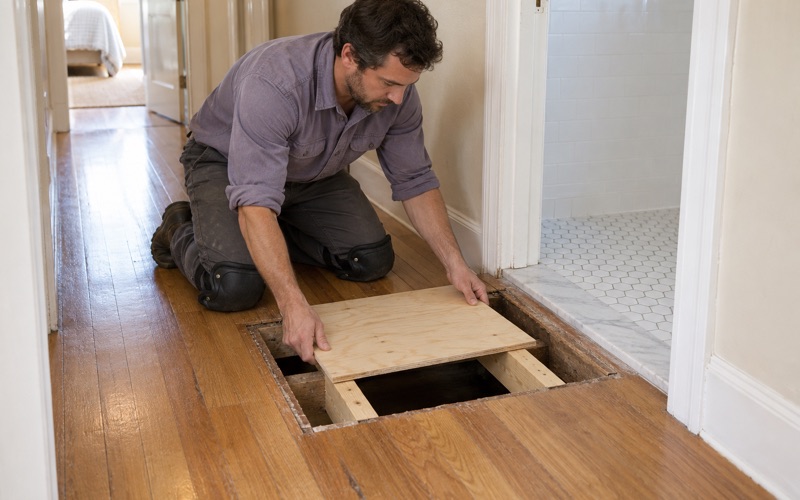
Soft spots, a bouncy hallway or a sag near a bathroom tell us to look at the subfloor and the floor joists before anything else. When the problem is structural rather than a flooring issue, we say so and refer it out rather than laying a new floor over it.
Old tile, mastic and lead-era finishes
Linoleum, rubber tile and 9x9 tile from this era, along with the black mastic often found under them, are treated as a possible asbestos question before anything is scraped or sanded. We recommend an asbestos survey where the material points that way, and we do not start removal until that is answered.
With 62.4 percent of Norwalk housing units built before 1960, most homes here are pre-1978 housing, so we follow lead-safe work practices under the EPA Renovation, Repair and Painting rule, with attention to lead dust from sanding. Finishes are chosen from products legal to apply in the South Coast air basin under the 275 g/L wood coatings VOC limit in SCAQMD Rule 1113.
Readings before material arrives
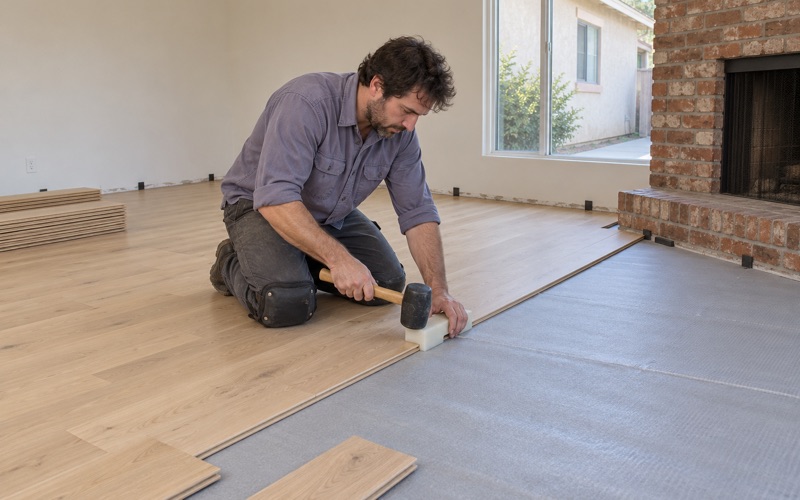
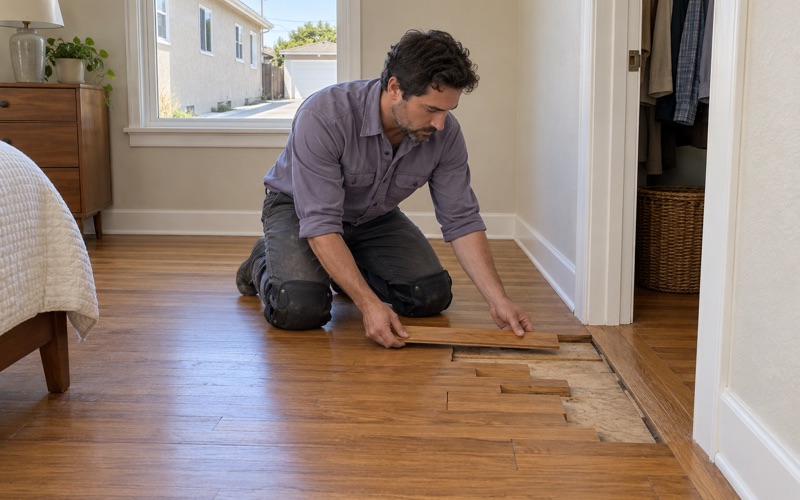
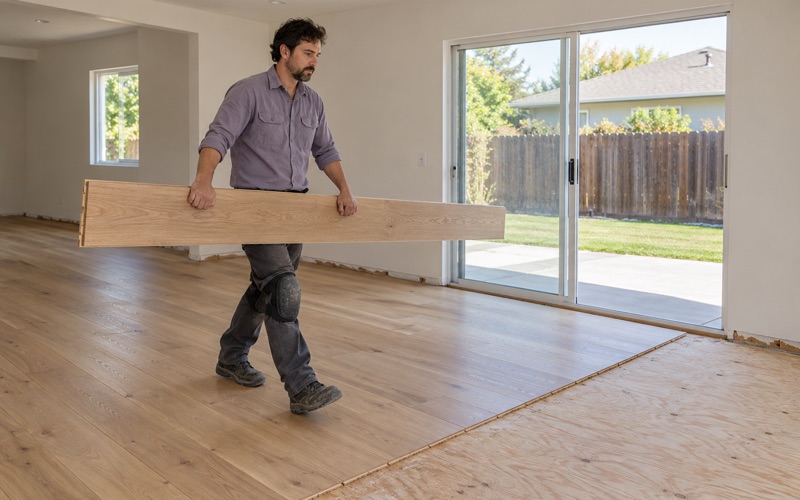
Before we order flooring, we take moisture readings in the existing wood with a wood moisture meter and in any concrete that will sit under a new floor. Those numbers are written down and stay with the estimate. Where a wall has come out or a room was added, new boards are woven into the existing floor so the repair does not read as a patch.
- 20+ Years in Wood Flooring
- Line-by-Line Written Estimates
- Lead-Safe Sanding on Pre-1978 Homes