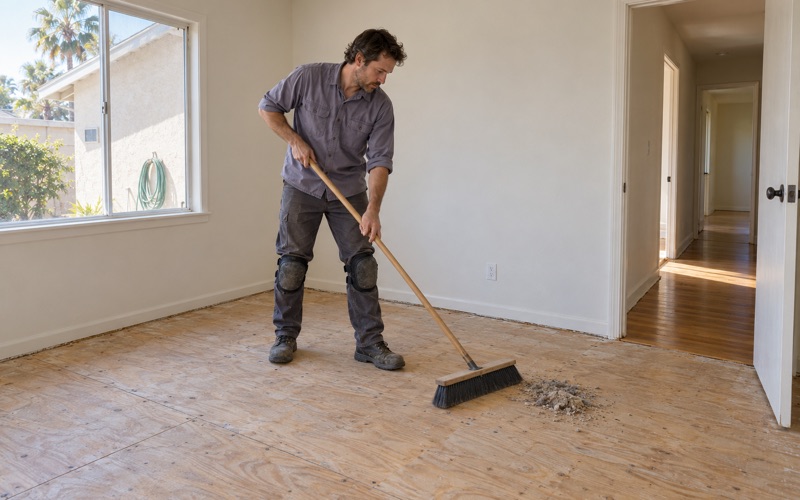
Lakewood Wood Flooring brings more than 20 years of work to wood-flooring in San Marino, and in this city the first question on most jobs is how much of the existing floor can stay. We start from the boards already in the room, not from a sample board in a showroom. A worn or stained floor is assessed for repair and refinishing before replacement is ever priced.
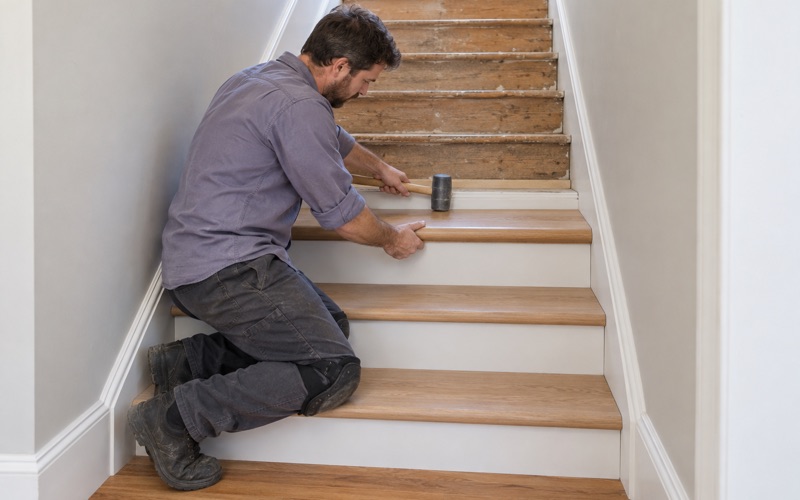
That assessment runs on measurements rather than impressions. We take moisture readings in the wood and in any concrete before material is ordered, treat old sheet goods and small square tile as a possible asbestos question before anything is scraped, and follow lead-safe practices in houses built before 1978. Estimates come itemized line by line, with stairs priced per tread and riser instead of folded into a square-foot figure.
The sections below cover how the city’s own preservation guidance talks about floors, why we patch before we tear out, how worn boards are replaced in kind, and how refinishing can bring a floor back without stripping away what makes it belong to its house.
What San Marino’s Preservation Guidance Says About Floors
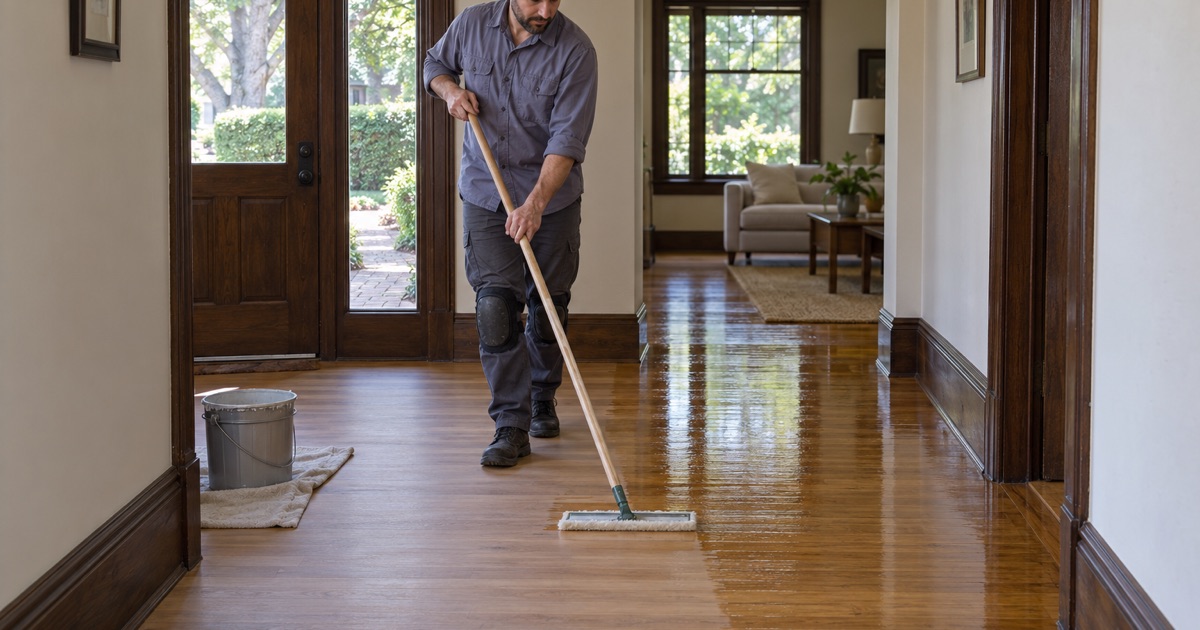
The City of San Marino publishes a Historic Preservation Guidelines leaflet inside its Architectural Styles and Preservation Guidelines document, which is linked from the city’s Historic Preservation page. It is undated advisory text, and it does not say which houses it applies to or whether interior work is reviewed at all. What it does offer is a clear way of thinking about an old floor, and that thinking matches how we approach one.
Flooring Is Named as a Character-Defining Finish
Under interior spaces, features and finishes, the leaflet says color, texture and pattern are important characteristics of finishes. It lists flooring alongside plaster walls and ceilings, trim, fireplaces and mantels, paneling, light fixtures and hardware. The floor sits in the same group as the millwork a visitor notices first.
We read that as a reminder that the tone of a worn floor, its grain and the direction its boards run all carry part of a room’s character. A replacement can match the width of the old boards and still read as new if its color, texture or laying pattern breaks from the rest of the house. We walk the rooms with that in mind before we suggest any change.
An Order of Work, Not a Wish List
The leaflet sets out its goals in a sequence. First identify, retain and preserve historic materials; stabilize deteriorated ones as a preliminary measure; protect and maintain them; repair them; and only then consider limited replacement in kind of extensively deteriorated portions. It describes preservation as the right treatment when the objective is to retain the building as it currently exists.
We follow the same sequence on a floor, whether or not the house has any formal status. Nothing in the leaflet settles whether a particular job needs a sign-off, and we do not present it that way. Questions about a designated landmark or a change visible from the street belong with the Community Development Department at 2200 Huntington Drive, while our part is the floor itself.
Looking for wood-flooring closer to Sierra Madre? See Sierra Madre Wood-Flooring.
Why Repair Comes Before Replacement Here
San Marino, incorporated in 1913 in the San Gabriel Valley, has a housing stock that makes this approach fit. American Community Survey estimates count 4,439 housing units in the city, and 92.9 percent of them were built before 1980. More than four in ten, 40.8 percent, date from 1939 or earlier, and the 1940s added 1,251 units, the largest single decade.
The stock is also almost entirely one kind of building. Of those 4,439 units, 4,377 are one-unit detached houses, which works out to 98.6 percent. A floor here usually belongs to one household in one freestanding house, and many of those floors have been walked on for most of a century.
Identify and Stabilize First
Our first visit identifies what is actually there: species where it can be read, board width, how the boards were fastened, and how far wear has gone into the wood. We look for cupping, crowning, board gaps, squeaks and nail pops, and we take moisture content readings with a wood moisture meter before forming an opinion. A floor that looks finished often has plenty of wood left above the tongue.
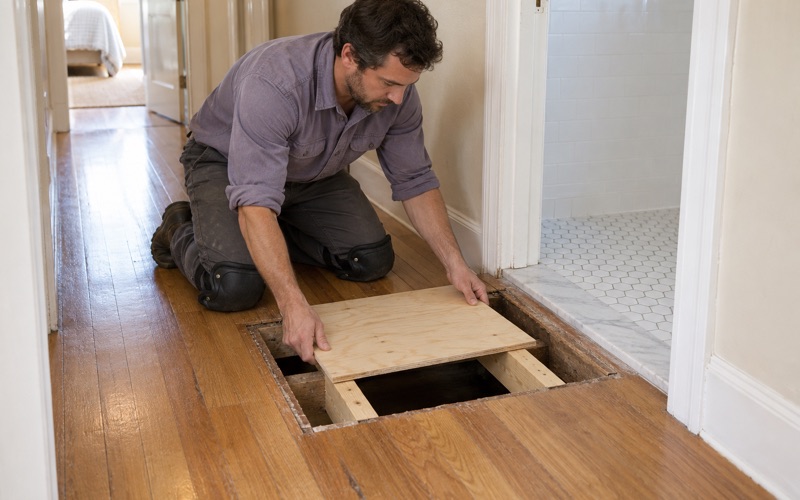
Stabilizing comes before any cosmetic work. Loose boards get refastened, a soft or bouncy spot is traced down to the subfloor and the floor joists, and anything that turns out to be structural is referred to the right trade rather than hidden under new finish. If a leak caused the damage, we find its source first and document it with photos and readings an adjuster can use.
Protect What Is Already Sound
Protecting a floor during other work is part of repairing it. When a kitchen, bath or addition is underway, sound flooring in the adjoining rooms is covered and kept dry so it does not become the next project. Older coverings such as linoleum, rubber floor tile or 9x9 tile are treated as a possible asbestos question before anyone lifts them to see the wood below.
Replacing Worn Boards in Kind
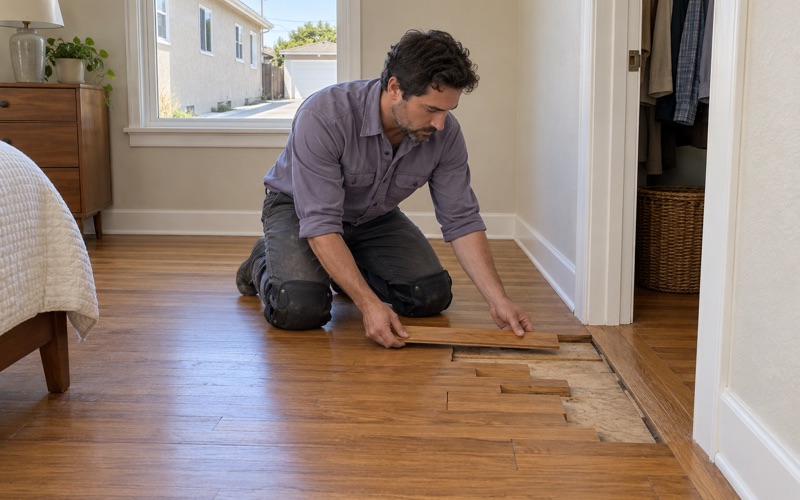
The leaflet’s phrase is limited replacement in kind of extensively deteriorated portions, and the word limited carries real weight. Replacement in kind means new wood that matches the old in species, width, thickness and profile, laid in the same direction and pattern. It is a patch, and the aim is that nobody can find it once the floor is finished.
Deciding Which Boards Have to Go
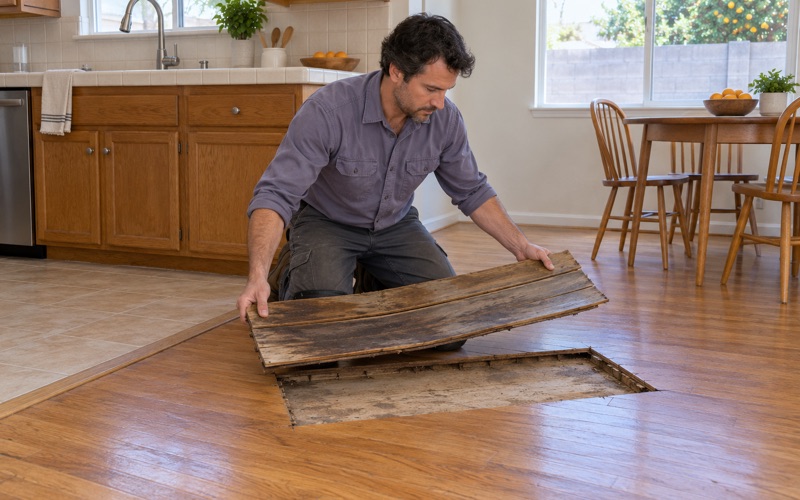
A board is replaced when it is split, rotted, stained through, or worn so thin that sanding would expose the tongue. Pet urine stains that have blackened the wood, water damage beside a sink or dishwasher, and old termite damage with frass are the usual reasons. Surface scratches, light graying and minor seasonal gaps are not; those are refinishing problems.
We mark the boards to be removed on the floor itself and walk the owner through them before any cutting. Each one appears as a line item on the written estimate, so the scope of replacement is plain and nothing grows quietly once the work starts.
Sourcing and Weaving In Matching Wood
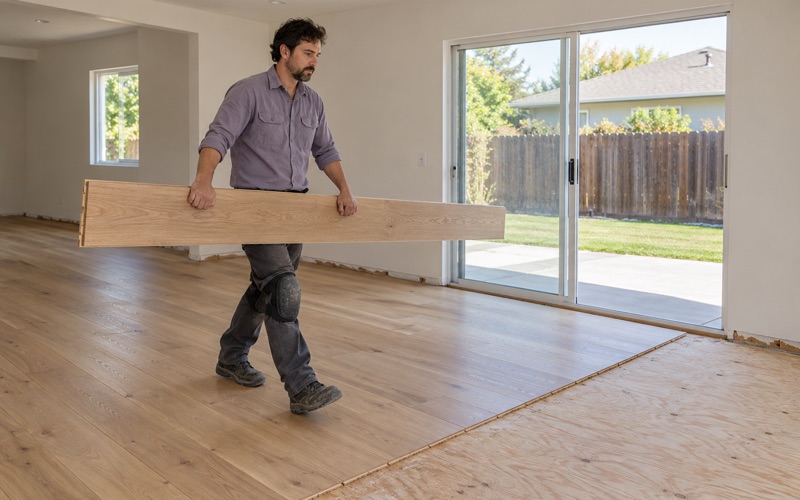
Matching wood starts with identifying the species and measuring the existing boards, not assuming them. Where the floor is a common species and width, new stock is selected or milled to match. Where it is not, boards can sometimes be salvaged from a closet or from under built-in cabinets that will be covered again.
Replacement stock is acclimated, and its moisture content is checked against the existing floor before it goes down. The new boards are then woven into the old ones rather than cut in along a straight line. Staggering the joints across several rows keeps the repair from reading as a rectangle, which is the difference between a patch and a floor that looks untouched.
Refinishing and Planning the Work in an Older House
Once repairs are in, refinishing is what brings the floor back together as one surface. It is also the step most likely to erase character if it is rushed. The goal is to remove damage and old finish while taking as little wood as possible.
Sanding With the Wear Layer in Mind
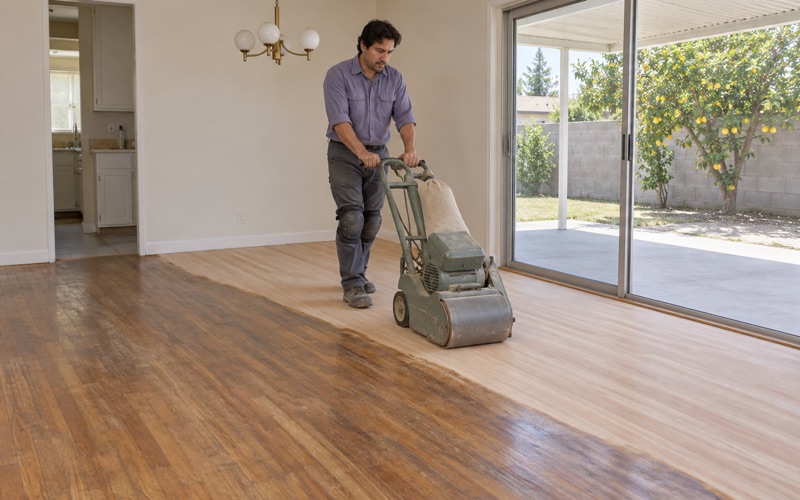
Each full sanding removes wood, and a floor that has been sanded several times may have little left above the tongue. We check thickness at a floor register or a removed board before choosing between a full sand and a screen and recoat. When a full sand is warranted, we use a drum sander, edger and orbital sander on a dustless sanding system, with a restrained grit sequence that takes off only what the damage demands.
In pre-1978 housing, sanding near painted baseboards and trim raises the question of lead dust. The EPA Renovation, Repair and Painting rule applies when painted surfaces are disturbed in those houses, and we set up containment and cleanup to match.
Keeping Color and Sheen Close to the Original
Stain and finish decide whether a refinished floor still looks like it belongs to its house. We test stain on sample areas, often on repaired boards and old ones side by side, so a blotchy stain or a mismatch shows up before it covers a room. Finishes come from products legal to apply in the South Coast air basin under the SCAQMD Rule 1113 wood coatings VOC limit of 275 g/L, including waterborne polyurethane, oil-modified polyurethane and hardwax oil.
Sheen level matters as much as color. A high-gloss coat on a floor that has long had a soft, low sheen can make a period room look remodeled even when most of its boards are the ones first laid there. We usually recommend a lower sheen for that reason and show samples in the room’s own light.
Scheduling Around the Household
Refinishing moves room by room, and each room is out of use while its finish cures. We work within local construction hours and hand over a written cure schedule, so the household knows when furniture can return and when rugs can go back down. The city’s draft housing element notes that multiple generations of a family commonly live together here, so we plan the order of rooms to keep a clear path through the house for everyone in it.
- 20+ Years in Wood Flooring
- Line-by-Line Written Estimates
- Lead-Safe Sanding on Pre-1978 Homes