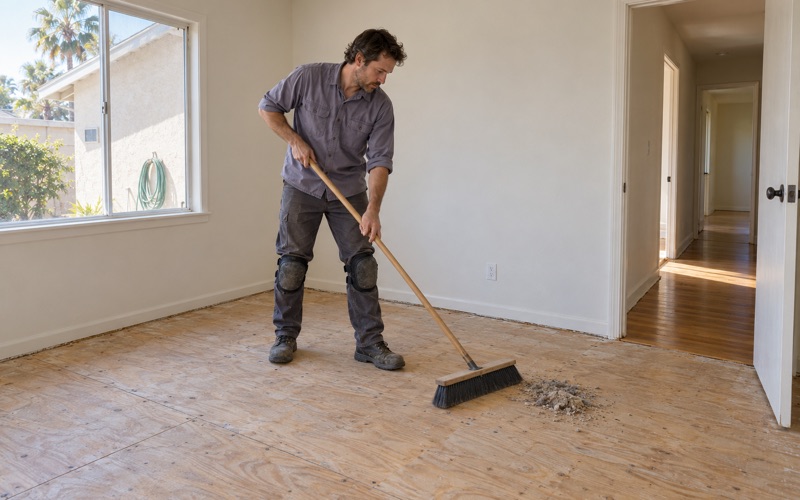
Lakewood Wood Flooring has spent more than 20 years on wood-flooring in Seal Beach and the towns near our shop, and the calls from this city often come from houses older than the ones around them. An owner lifts a corner of carpet and finds boards, or a hallway patched twice over starts to squeak and dip underfoot. Floors like those need a slower start than a newer house does.
Our first visit is about finding out what is really there. We read moisture in the wood, check what sits under each layer of covering, and follow any soft spot down toward the framing before a price goes on paper. Nothing is scraped or sanded until we know what it is made of.
The sections below explain why only a small share of Seal Beach homes carry that older layer, and what it changes about refinishing, repairing or replacing a floor inside one of them.
From Bay City to a Resort Town
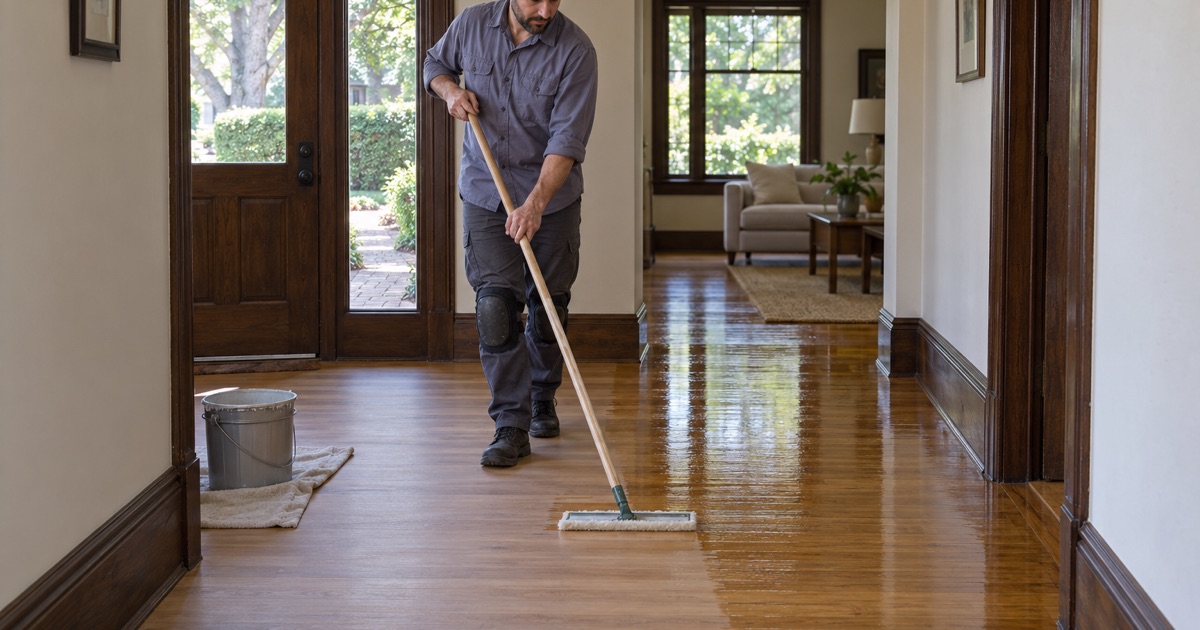
Seal Beach did not start as a suburb. The city’s General Plan Cultural Resources Element records that in 1903 the area was subdivided and named Bay City, and that the Pacific Electric Red Cars arrived the next year, connecting it to Los Angeles. A pier followed in 1906, which the element calls the longest pier south of San Francisco.
Incorporation in 1915
In 1915 Bay City incorporated with a population of 250 and became known as Seal Beach. A town that small leaves a thin layer of buildings, and later decades built over and around much of it. When we work in a house from those years, we treat it as one of relatively few survivors rather than a common type.
The 1920s building flurry
According to the element, by the 1920s the town was at its height as a resort community, and that success prompted a flurry of construction. Growth kept going until the Great Depression. Accounts of Old Town describe its first homes as modest wooden bungalows and cottages near the new pier, followed by Arts and Crafts bungalows through the 1910s and 1920s.
What a resort-era house means for its floor
A cottage built for a resort town has usually been enlarged, closed in or re-floored more than once in the century since. Porches become bedrooms, kitchens move, and each change can leave a seam where old boards meet newer material. We read those seams as part of the house, and we do not assume the species, width or age of a floor until we have looked under it and along its edges.
Looking for wood-flooring closer to Carson? See Wood-Flooring Services in Carson.
The Wartime Boom and the 1960s Majority
A second wave arrived with World War II. The Cultural Resources Element says the influx of military personnel brought a second major boom in construction, and that the town kept expanding through the 1950s. The city’s housing element adds that the U.S. Navy acquired half of the city in 1944 to build the Naval Weapons Station.
How small the older layer is
Census estimates show how rare the early houses are. Of 14,632 housing units in Seal Beach, 509 were built in 1939 or earlier, just 3.5 percent, and another 477 date from the 1940s. By contrast, 8,413 units, or 57.5 percent, went up in the 1960s, so the city most visitors see is a 1960s city with an older layer tucked beneath it.
Why the split matters for flooring
A 1960s unit and a 1920s cottage call for different first questions. The newer house tends to have a more predictable build-up under the finish floor, while the older one may hide a board subfloor, several layers of covering and repairs from several owners. We plan each visit around the house in front of us rather than the city’s average, because here the average describes a very different building from the oldest ones.
Houses from the war years
A construction boom means many houses finished in a short span, and eight decades later each one carries its own record of repairs. Some have had rooms added, some have been re-covered wall to wall, and some still show the floor they were built with. We check fastening, joist condition and the subfloor before promising that a refinish will hold, because a sound surface over a tired structure does not stay sound.
Floors in Seal Beach’s Oldest Houses
Most of the work in these homes starts below the visible surface. Here is what we look for before any sanding begins.
Looking under the covering
Older rooms often carry carpet over linoleum, rubber tile or 9x9 tile, sometimes with black mastic still stuck underneath. We treat every one of those materials as a possible asbestos question and arrange an asbestos survey before anything is scraped, ground or sanded. If the survey calls for abatement, that work is done by the right specialists before our crew returns.
Lead-safe sanding
Nearly every older home in the city predates 1978, so we follow lead-safe work practices under the EPA Renovation, Repair and Painting rule. Sanding old finishes, painted baseboards and shoe molding can raise lead dust, which is why we contain the room, run a dustless sanding system where the floor allows it, and clean to a standard instead of by eye. Owners with children or grandchildren visiting get a clear account of when each room is safe to use again.
Sags, bounce and squeaks
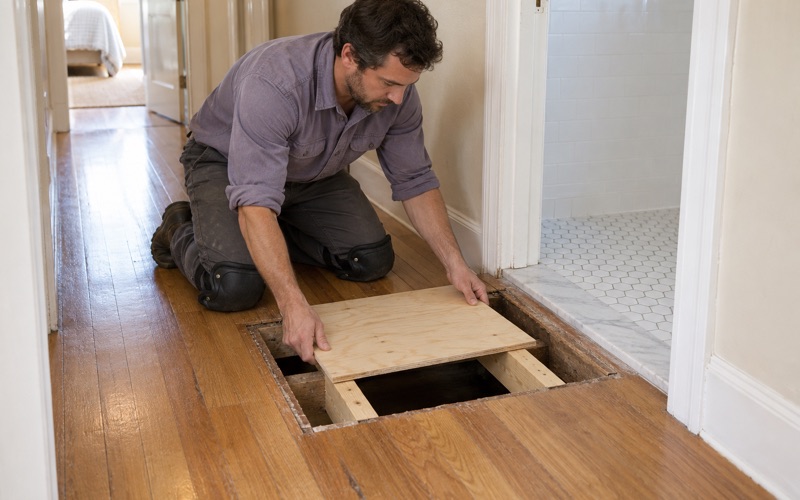
A bouncy floor or a sagging spot near a doorway is a structural question before it is a flooring one. We trace soft areas down to the subfloor and the floor joists, and when the fix calls for joist sistering or framing work beyond a flooring job, we refer it out and put that in writing. Squeaks and nail pops usually quiet down once the cause is found and the boards are refastened.
Patching where the house changed
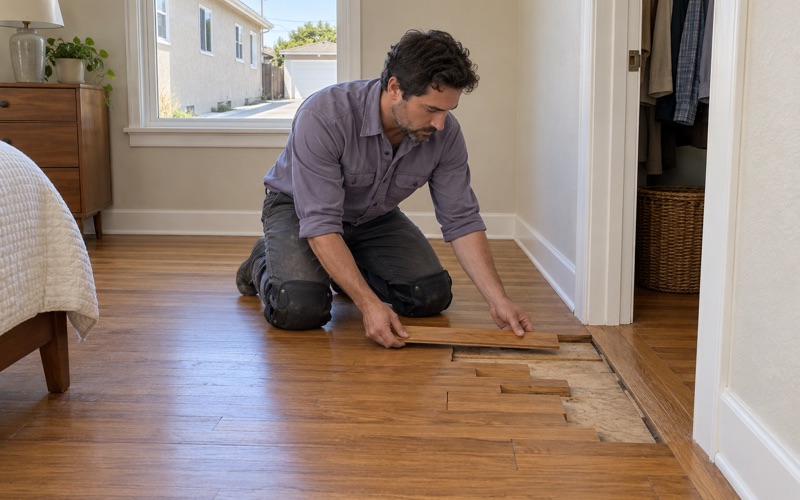
Where a wall came out or a porch was closed in, the floor often shows a line where two eras meet. We weave new boards into the existing floor, staggering the joints so the repair does not read as a patch, and match width and grain as closely as available stock allows. Every replacement board is acclimated and checked with a wood moisture meter so its moisture content matches the floor around it.
Caring for an Unlisted Older Home
The Cultural Resources Element names only a few protected buildings. Old City Hall on 8th Street is on the National Register of Historic Places, and the Krenwinckle House and the Proctor House are locally listed. The element also notes that many structures from the town’s history, though not officially listed, contribute to the community’s identity.
What an unlisted house leaves to the owner
The element’s stated policy is to identify, designate and protect buildings of historic importance, and it calls for a city inventory of historic and cultural landmarks. For most older houses, though, no listing exists, and the choices about an old floor rest with the owner. We give those owners a straight comparison of keeping, repairing and replacing, so a sound original surface is not torn out just because replacement was the first idea on the table.
Refinishing before replacing
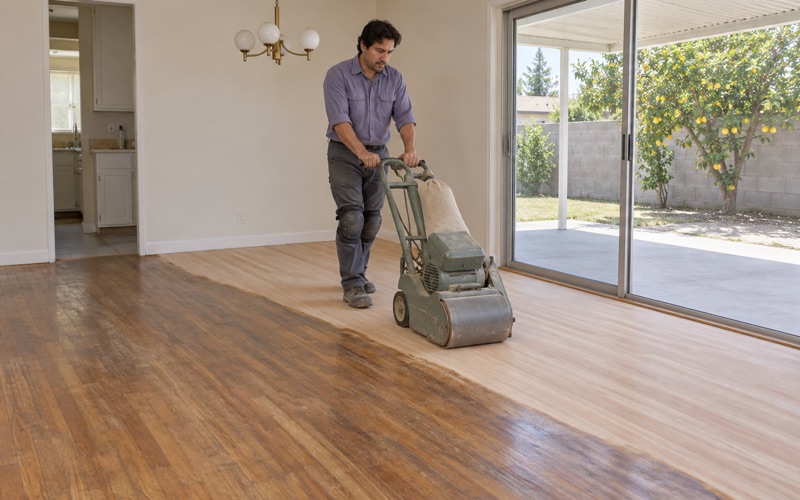
A solid wood floor with enough wood left above the tongue can usually be sanded again. We work through a grit sequence with a drum sander, an edger and an orbital sander, and we test stain on a small area first, since red oak and maple take color differently and a blotchy stain is hard to undo. Where the existing finish is sound and only dull, a screen and recoat can restore the sheen without taking the floor down to bare wood.
Older floors also tend to carry old finish problems, such as peeling polyurethane over a waxed surface or an amber tone that owners describe as orange oak. Sanding to bare wood clears both, and it lets the owner choose a new color and sheen level instead of living with a choice made decades ago. We show finished samples on the actual boards before the whole room is coated.
When boards have to go
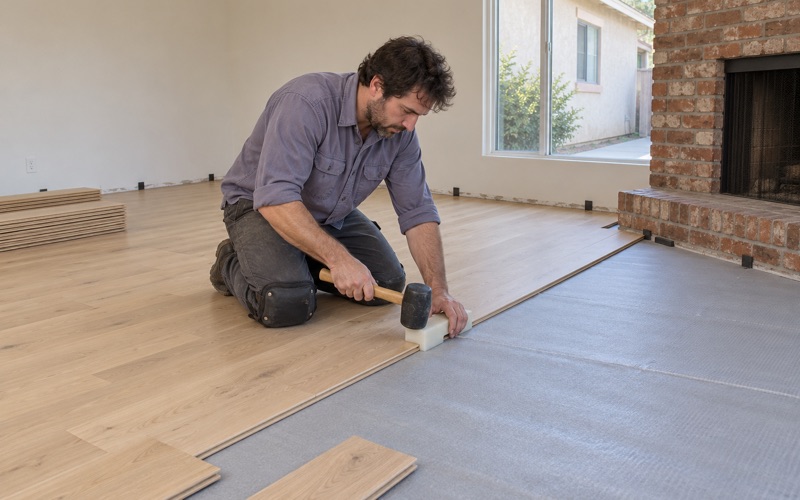
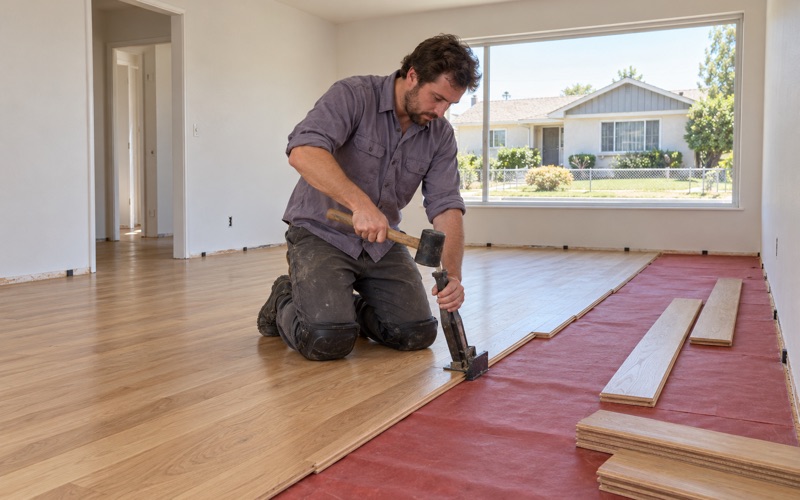
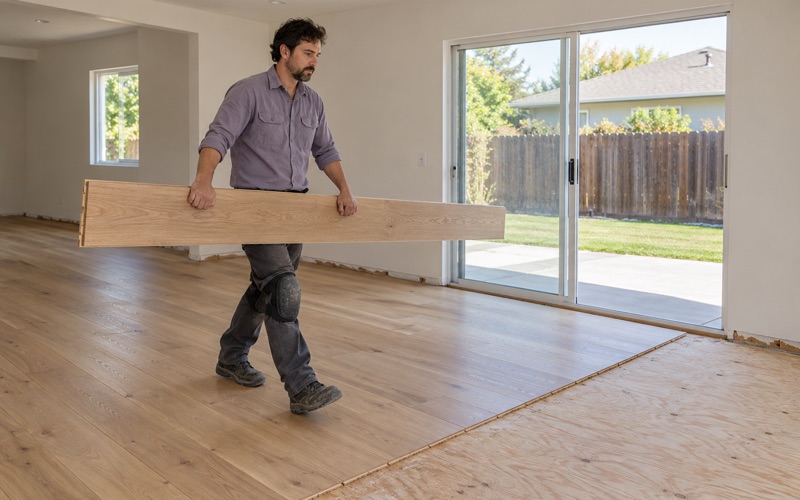
Some floors are too thin, too damaged or too patched to sand again. In those rooms we talk through engineered flooring with a thick wear layer, or nail-down solid wood fastened with a cleat nail or flooring staple where the subfloor will hold it. We weigh species partly by Janka hardness rating, since a household with a large dog will dent a soft wood faster than white oak or hickory, and we lay out wide plank or a herringbone pattern so it respects the room’s doorways.
Moisture, finishes and schedule
We measure moisture in the wood and in any concrete before material is ordered, write the readings down, and acclimate new flooring according to NWFA installation guidelines. Every finish we apply meets SCAQMD Rule 1113 and its 275 g/L limit for wood coatings, whether the owner prefers waterborne polyurethane, an oil-modified product or a hardwax oil. A written cure schedule tells the household when each room can take foot traffic and furniture again.
Leaks, estimates and stairs
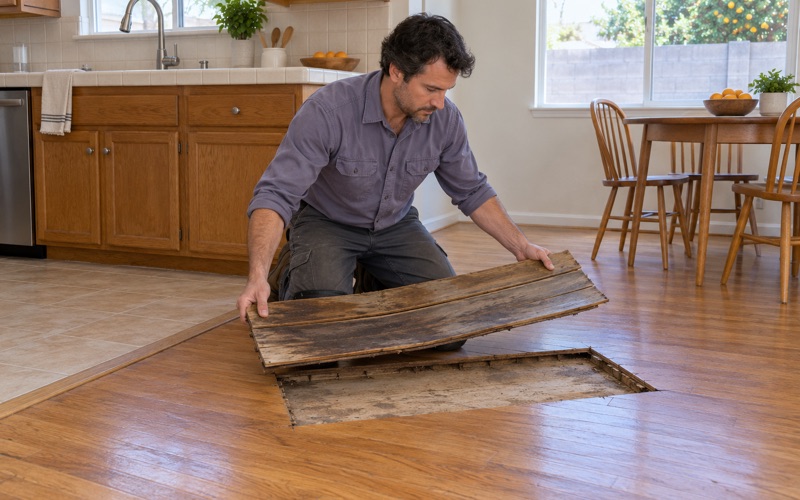
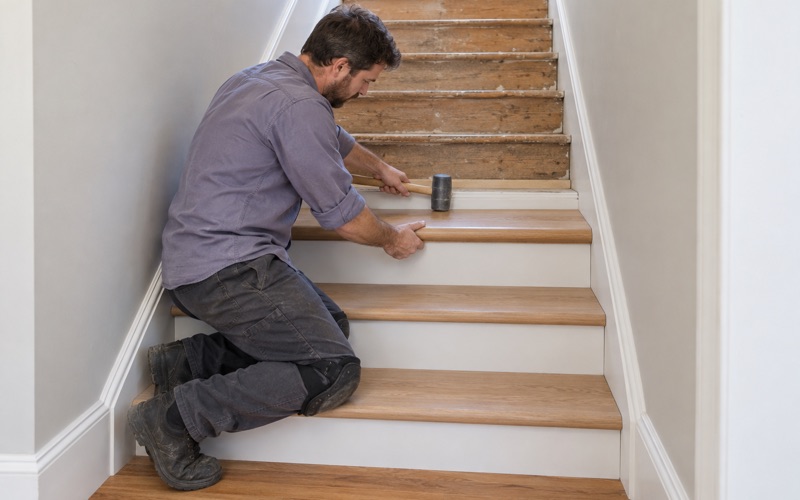
When a dishwasher line, a water heater or an aging pipe has soaked an old floor, we find the source before touching the boards. Photos and moisture readings document the damage for an adjuster, and our estimate is written line by line, the format the California Department of Insurance tells homeowners to ask for on a claim. Stairs are priced per tread and riser rather than folded into a square-foot figure, which matters in older houses where each step may need different work.
- 20+ Years in Wood Flooring
- Line-by-Line Written Estimates
- Lead-Safe Sanding on Pre-1978 Homes