Lakewood Wood Flooring has handled wood flooring in Signal Hill for owners who noticed something off underfoot, and in more than 20 years we have learned that the first question is rarely which board to buy. A door starts to drag, a row of boards dips toward one wall, or a finish that looked sound last spring opens a crack along a seam. Each of those is a question to answer with measurements before anyone prices a new floor.
We refinish, repair and install hardwood and engineered floors, and every job starts the same way. We take moisture readings in the wood and in any concrete, run a level and a straightedge across the rooms in question, and look at the subfloor and joists wherever we can reach them. The readings go in writing, so the owner keeps a record of what the floor looked like before we touched it.
This page covers a problem that is more common in a hillside city than on flat tract ground: telling a floor that has failed from a floor that is only reporting what is happening beneath it. We fix floors. When the evidence points past the floor, we say so and step back.
Wood Floors in a City With Mapped Ground Hazards

Signal Hill is a small city, about 2.2 square miles, and part of it sits high on the hill that gives the city its name. That hill is the reason the ground conversation here is different from the one in most of the surrounding area.
What the city’s hazard map shows
The city’s 2016 Safety Element includes a seismic hazards map, and that map is reproduced as Figure 3-1 in the city’s July 2026 Overlay Zoning District Initial Study. Its legend carries four classes: landslide movement hazard, undeveloped land with landslide potential, liquefaction hazard, and undeveloped land with liquefaction potential. The landslide classes appear on the hill itself.
Read by eye, the figure puts the landslide movement strip on the upper east side of the hill, with undeveloped land of landslide potential beside it. Liquefaction appears instead in low ground toward the city’s edges. It is a small-scale map, so we never use it to place a particular house, lot or street in either class, and neither should anyone selling you a floor.
Five hazards on the city’s list
The same study summarizes the city’s 2025 Hazard Mitigation Plan, which names five primary hazards: earthquakes, landslides, windstorms, drought and flooding. Landslides being on that short list tells you the city takes slope ground seriously as a planning matter.
For a homeowner, that list is context rather than a diagnosis. It explains why a sloping floor in this city deserves a careful look, and it says nothing about why any single floor slopes.
Looking for wood-flooring closer to Paramount? See Paramount Wood-Flooring.
Slope Ground Versus Low Ground
Two houses a few minutes apart in Signal Hill can sit on very different ground. One may stand on a graded pad cut into the hill, and another may sit on flat, lower land near the city line. The floor questions differ between them, even when the symptom looks the same.
Graded pads and retaining walls
The General Plan’s Land Use Element describes the development envisioned in the 1991 Hilltop Area Specific Plan as involving grading of the hillsides and construction of retaining walls and pads for new dwellings. Much of the newer hillside housing sits on ground shaped that way, and the city’s largest building decade was the 1980s, at 23.0 percent of its housing units.
A house on a graded pad is not a problem house, but it does raise questions a flat-lot house does not. Where did the cut end and the fill begin, which side of the house faces the retaining wall, and does the dip in the floor run toward it? We note those observations for the owner, and we do not guess at what the pad is doing.
Low ground at the city’s edges
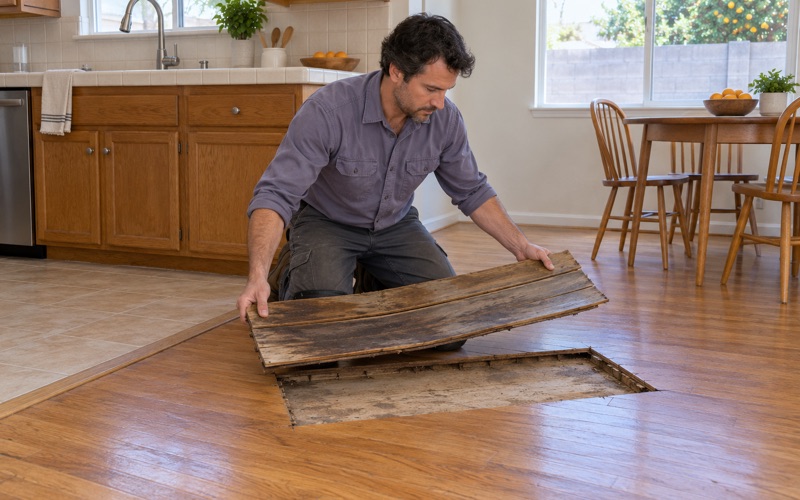
Low ground brings its own set of floor questions, and most of them are about water rather than slope. A floor near a lower edge of the city that cups or lifts is more often answering to a supply line leak, a water heater leak or a slab that has never been tested than to anything mapped. Liquefaction is an earthquake behavior, and it is not a reason an everyday floor moves.
That is why our moisture work is the same on every lot. We use a wood moisture meter on the boards and, over concrete, a calcium chloride moisture test or an ASTM F2170 in-situ relative humidity test before any material is ordered.
What the city is still studying
The 2021 Housing Element study describes the soils that dominate Signal Hill as having limited expansion potential, with moderate potential only in clayey sections. The Overlay study adds that a geotechnical report is being prepared for its district and leaves the liquefaction and expansive-soil questions there to an environmental impact report.
In other words, the city itself is waiting on engineers for its own district-level answers. A flooring contractor who tells you what the ground under your house is doing, without that kind of study, is guessing.
Checking Level Before Blaming the Floor
Most out-of-level floors we see have an ordinary cause that sits between the finish boards and the foundation. Finding it first saves an owner from paying for a new floor that inherits the same fault, and it saves the ground from taking the blame for a sagging joist.
What we measure
We run a long level and a laser across the room and record how far the surface falls and in which direction. We check whether the dip follows a joist line, a bearing wall, an old doorway or a patched section of subfloor. We also compare door gaps, cabinet reveals and baseboard lines, because a pattern across the house means something different from one soft spot by the dishwasher.
Moisture readings go next to the level readings. A floor that is both low and wet is a different job from a floor that is low and dry, and the notes show which one we found.
Floor causes we can find and fix
Many of the symptoms that worry owners are flooring problems in plain terms. Cupping and crowning follow moisture, board gaps follow seasonal drying, squeaks and nail pops follow loose fasteners, and a bouncy or sagging floor very often traces to an undersized, notched or damaged floor joist. Those have known repairs, from board replacement and a weave-in repair to joist sistering done under the right trade.
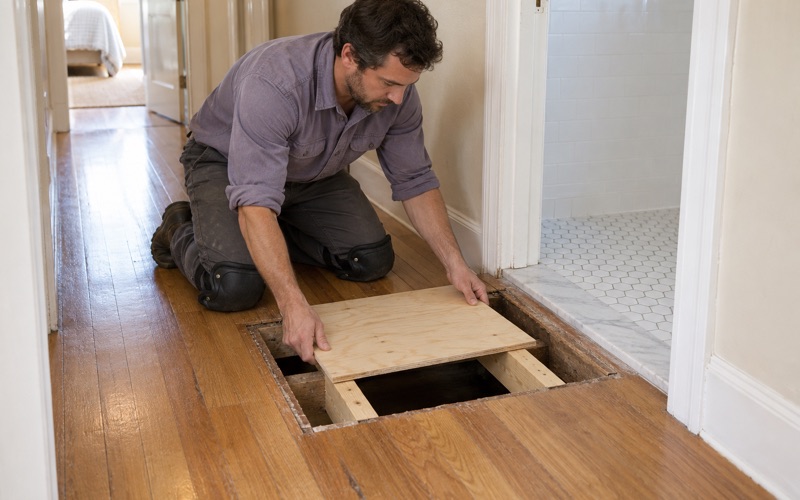
We trace soft and sagging spots down to the subfloor and joists before a finish floor is priced. If a joist, beam or support needs structural work beyond a flooring job, we refer that out and write down what we saw.
When the answer is not a flooring answer
Some readings do not fit a floor cause. A crack that runs through the floor and continues up a wall, a slope that crosses joist lines and follows the fall of the lot, or a gap that keeps growing between visits all point past the finish. In those cases we stop pricing boards and tell the owner that the next call belongs to an engineer.
We do not claim that any Signal Hill floor has moved because of the ground, and we do not offer a repair guarantee against ground behavior. What we can offer is a clear record of what the floor measured, which is useful to whoever the owner calls next.
Planning Floor Work in Signal Hill
Once the cause is understood, the floor itself is the easy part. The choices below are the ones we walk through on a hillside house or a low-lot house alike.
Materials and installation on real-world floors
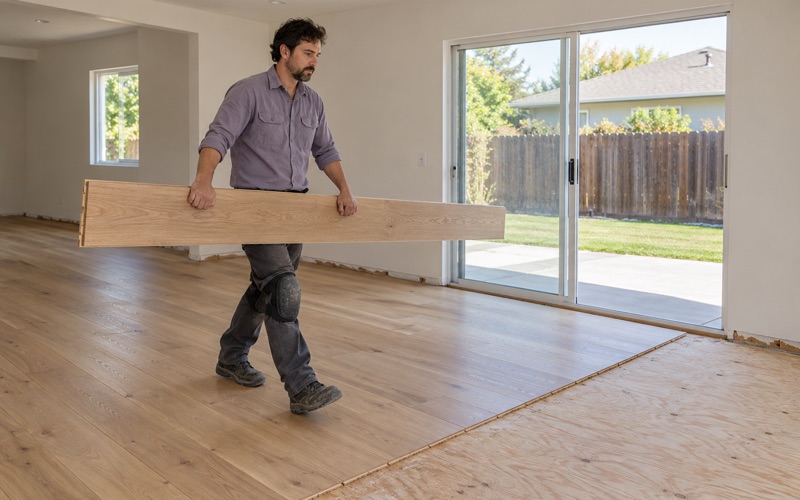
Engineered floors with a stable engineered core construction tolerate small seasonal changes well, and the wear layer thickness decides how many sandings a floor has in it. Solid white oak, red oak, hickory and maple each carry a different Janka hardness rating, which matters in a busy kitchen or on stairs. A nail-down installation over plywood underlayment, a glue-down over tested concrete or a floating installation each has its place, and each follows NWFA installation guidelines for acclimation and an expansion gap at the walls.
On a floor that has been leveled after a joist repair, we check flatness again before the first board goes down. Stairs are priced per tread and riser, with nosing and reducer strips listed separately.
Finishes, dust and older houses
Nearly half of the city’s housing units were built before 1980. On houses built before 1978 we work lead-safe under the EPA Renovation, Repair and Painting rule, with a dustless sanding system to control lead dust from sanding. Old linoleum, rubber floor tile, 9x9 tile and black mastic are treated as a possible asbestos question, with an asbestos survey before anything is scraped.
Finishes come from products that meet the 275 g/L wood coatings VOC limit under SCAQMD Rule 1113, whether the owner wants waterborne polyurethane, oil-modified polyurethane or a hardwax oil finish. We confirm sheen level on a sample board before the whole room is coated.
Estimates and the schedule
Every estimate is written line by line, so an owner or an adjuster can see exactly what each item costs. Where water damage is involved, we photograph it and log moisture readings in a form an adjuster can use.
We work inside permitted construction hours and hand over a written cure schedule showing when each room can take foot traffic and furniture again. For a household on a slope, where rooms often step between levels, that schedule is how the family plans its week.
- 20+ Years in Wood Flooring
- Line-by-Line Written Estimates
- Lead-Safe Sanding on Pre-1978 Homes